Time & Tide
Moored Life has its Ups and Downs
BY AUDREY NELSON
Photos by Annie Graebner
On a recent rain-soaked Wednesday, Ben Doerr prepared to do what he does best: talk about boats.
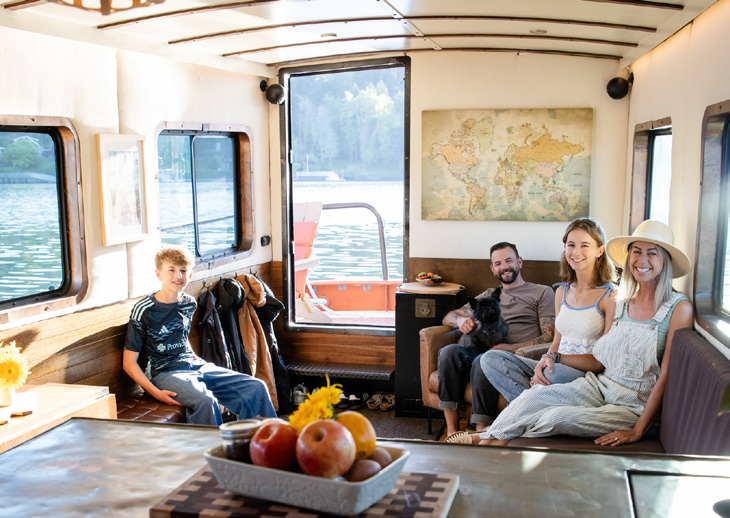
Doerr wears many hats. He’s a father, a husband and a musician. He’s a professional mariner. He owns Sail Bainbridge—a private boating tour company—and co-owns The Chandlery, a retail hub for Bainbridge boaters tucked away behind Pegasus Coffee House. Last, but certainly not least, Doerr is a passionate “liveaboard.” He, his wife Deb Henderson and the couple’s two children live onboard an old fire tugboat in Eagle Harbor.
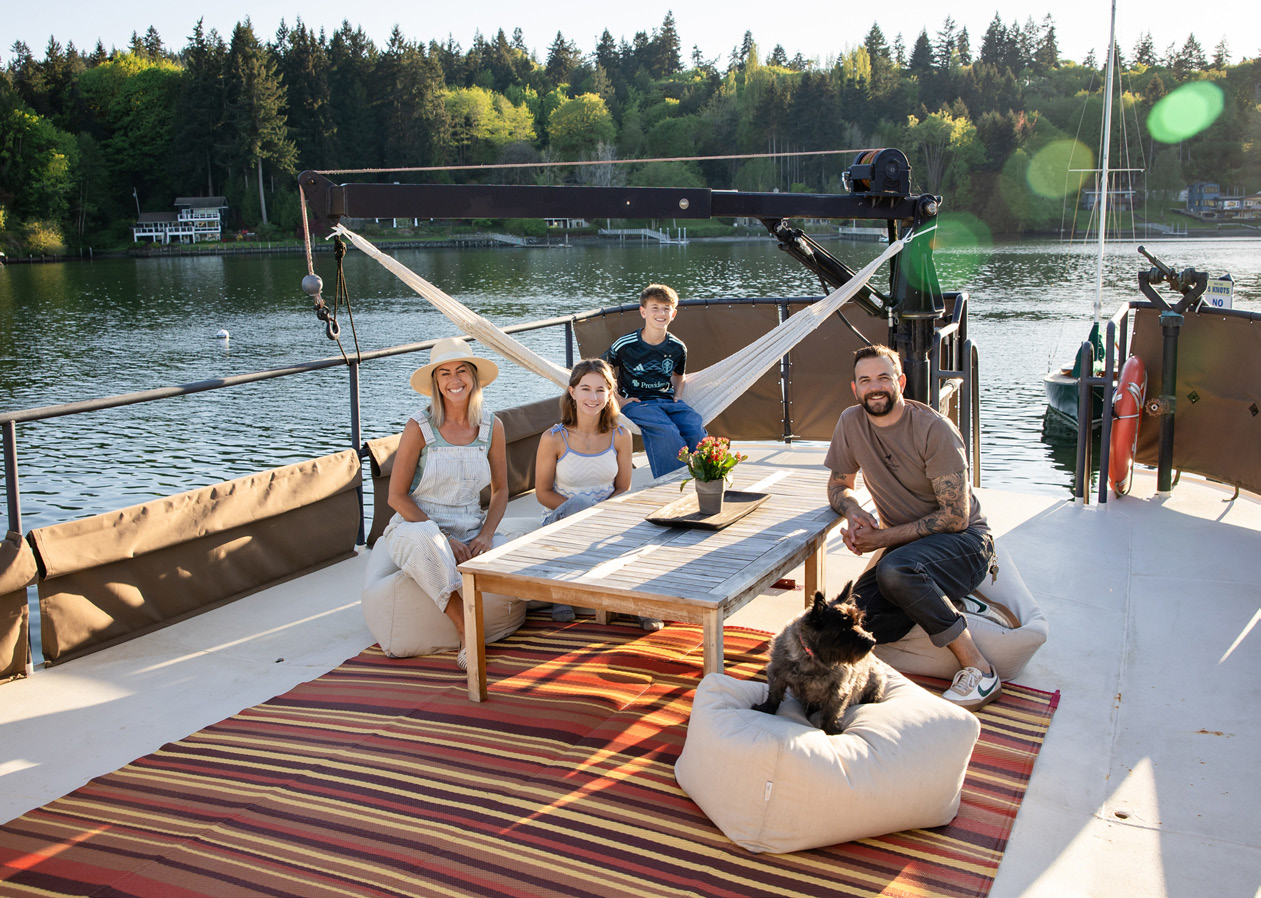
It might surprise some land-dwelling Bainbridge residents to know that the island has a thriving liveaboard community. Doerr could not provide exact numbers—in part because a few permanent liveaboards fly under the city’s radar—but he estimates that some 40 boats are moored in Bainbridge waters.
Harbour Marina, situated just below the Harbour Public House, currently hosts 22 liveaboard vessels, the most of any island marina. The Dave Ullin Open Water Marina—in the center of Eagle Harbor—has moorings for another 16. A few other boats are scattered across various island moorings, including Eagle Harbor Marina on the harbor’s south side.
Since most of Bainbridge’s liveaboards are concentrated in Eagle Harbor, the Marina District—the portion of Winslow between the bottom of Madison Avenue and the water—has become a hub for the community.
“It’s a really vibrant group that cares for each other and looks out for each other,” Doerr said of his fellow liveaboards.
Doerr has loved the water for as long as he can remember. He grew up in Missouri—“not a bastion of sailing,” he admitted—but visits to his grandfather’s home in Florida sparked his desire to one day sail around the world.
After high school, Doerr raced sailboats on Lake Michigan and spent some time in landlocked New Mexico—“also not a lot of sailing,” he confirmed. Eventually, he ended up in Seattle. He was delighted, expecting that proximity to the water and “friends with boats” meant he’d be sailing all the time.
But he soon faced a harsh reality. “People here don’t use their boats!” he said.
Early in Doerr’s marriage, he and Henderson had been tempted to buy an old house barge anchored on Lake Union. But a real estate agent talked the couple out of it. As a result, Doerr and Henderson lived on land for many years—first in Seattle, then on Bainbridge. They owned a few different sailboats during that time, but it wasn’t until 2015 that they decided to buy a boat big enough for their family to live on during the summers.
The new boat, “True,” was expensive, and Doerr and Henderson started Sail Bainbridge to pay for it. As touring business boomed beyond Doerr’s expectations, he, Henderson, and their two kids spent their summers sharing “True” with Sail Bainbridge customers, juggling carefully organized bins of their belongings as they trekked to and from the house they still owned. Finally, Henderson proposed that the family rent out that house, buy a second boat, and live aboard it full time.
“And I was like, ‘Are you insane?’” Doerr said, laughing.
His hesitation didn’t last long. He and Henderson bought “Topaz,” a classic wooden boat, and began their liveaboard saga in earnest.
The first thing they learned? “Every boat is a sacrifice,” Doerr said. “If you have less than $200,000 to spend on a boat—far less, in our experience—you kind of have to work with what you get.”
There were other things to get used to, like constant maintenance, small spaces and the many whims of nature. Doerr also spoke to the difficulty of selling “Topaz” and acquiring “Ewen Ross” once his family decided they needed more space. (“Ewen Ross” boasts a generous 500 square feet: about the size of a large studio apartment.)
In general, Doerr is upfront with people who have an overly romantic view of life on the water. If you think living aboard is easy, he warns them, then don’t do it.
Still, as a naïve landlubber, it’s easy to be swayed by Doerr’s descriptions of the best parts of liveaboard life. “Living in a tidal zone is pretty amazing,” he said. “There’s this breath and swell happening every day. Your whole existence is like, the bathtub drains out and refills.”
No one understands and appreciates that poetic “breath and swell” better than Doerr’s close friends, married couple John and Becca Guillote. While Doerr and his family live at a dock to prioritize walkability into town, John, Becca and their 3-year-old daughter lead more remote lives. They spend most of the year on a boat attached to an open-water mooring ball.
“At a dock, you’re just stuck looking at the same thing,” John said. “You sit down to dinner and you look at the exact same boat right next to you. [But] when you sit down to dinner out on the mooring ball, you have no idea—it just depends on what direction the wind is blowing as to what view you get.”
There are many ways to live aboard. Doerr and his family treat their boat like a house that remains mostly in one place. In contrast, the Guillotes love to “cruise,” which John described as an “RV across the country trip—except wherever you want to go.” They’ve traveled as far as French Polynesia and the Caribbean.
The Guillotes’ far-ranging lifestyle has given them a relaxed, optimistic attitude; when the family comes home to Bainbridge, they’re well equipped for the unique challenges of open-water life. Those challenges include managing their own sewage tank, maintaining an independent electricity grid and taking their daughter to school in a dinghy each morning.
About two years ago, the Guillotes solved one challenge for good when they received a parking pass and a mailing address from the city. It was a huge change—symbolically, but also logistically. Overnight, the documentation made it easier for John and Becca to bank.
“It’s easy to slip through the cracks in this lifestyle,” Becca said.
City government has made a commitment to preserve Bainbridge’s maritime culture and make life easier for its tenants. Recently, the council agreed that when a buoy at the Dave Ullin Marina opens, priority will be given to applicants who make below $39,000 a year. These tenants, if approved, will pay a reduced monthly moorage fee of $200, about half the standard rate.
The council’s decision to prioritize low-income tenants did not legally make the Dave Ullin Marina an affordable housing site. Even so, Doerr has concerns about the new policy, worrying that it may encourage derelict vessels, which pose safety risks to other harbor tenants. He emphasized that boats are depreciating assets, and that maintenance is a constant expense. Simply providing an inexpensive buoy does not, on its own, make living aboard safe and affordable.
Still, there’s no doubt that with Bainbridge’s high cost of living, comparatively low moorage fees make island life more accessible for people who might otherwise miss out. And Doerr of all people understands that draw—to Bainbridge, and to the waters around it.
“None of this is logical,” he said. “None of this is financially wise, for the most part. It’s all a world of passion. We love the water. We love what it brings.”