
THE JOB
A MORNING AT BIFD’S STATION 21
BY AUDREY NELSON
PHOTOS BY DINAH SATTERWHITE
Lieutenant Dag Liljequist swung down from a fire engine, landing boots-first in the wide bay of Bainbridge Island Fire Department’s Station 21. It was around 11 a.m. on a Friday, and Liljequist and the rest of his on-duty crew had just returned to the Madison Avenue station after a false alarm on the island’s south end.
As Liljequist climbed out of his heavy jacket, pants and boots, firefighter/EMT Sean Tully examined the back of a nearby ambulance. Typically, Tully does his “rig check” at the beginning of his 48-hour shift—“making sure that everything’s kind of back in order, ready to go,” he explained—but a medical call earlier in the morning had disrupted his routine. After finishing his check, he headed inside the station, calling back to Liljequist, “I’m gonna go write that report.”
“Thanks, Sean,” Liljequist replied.
In many ways, firefighting seems like a glamorous profession. When a call comes in, Bainbridge firefighters rush to respond, aiming to suit up and leave the station in less than 90 seconds. These men and women are highly trained and cool under pressure, deploying from three different stations and providing support for house fire and emergency services calls, as well as rescue swimming operations and interstate wildfire responses. In 2024, they responded to a record-high 3,913 calls for service across the island.
But in order for BIFD firefighters to perform well during the heart-pounding, life-saving parts of their jobs, they must spend most of their shifts putting in unglamorous work: writing reports, running gear checks, doing drills and working out.
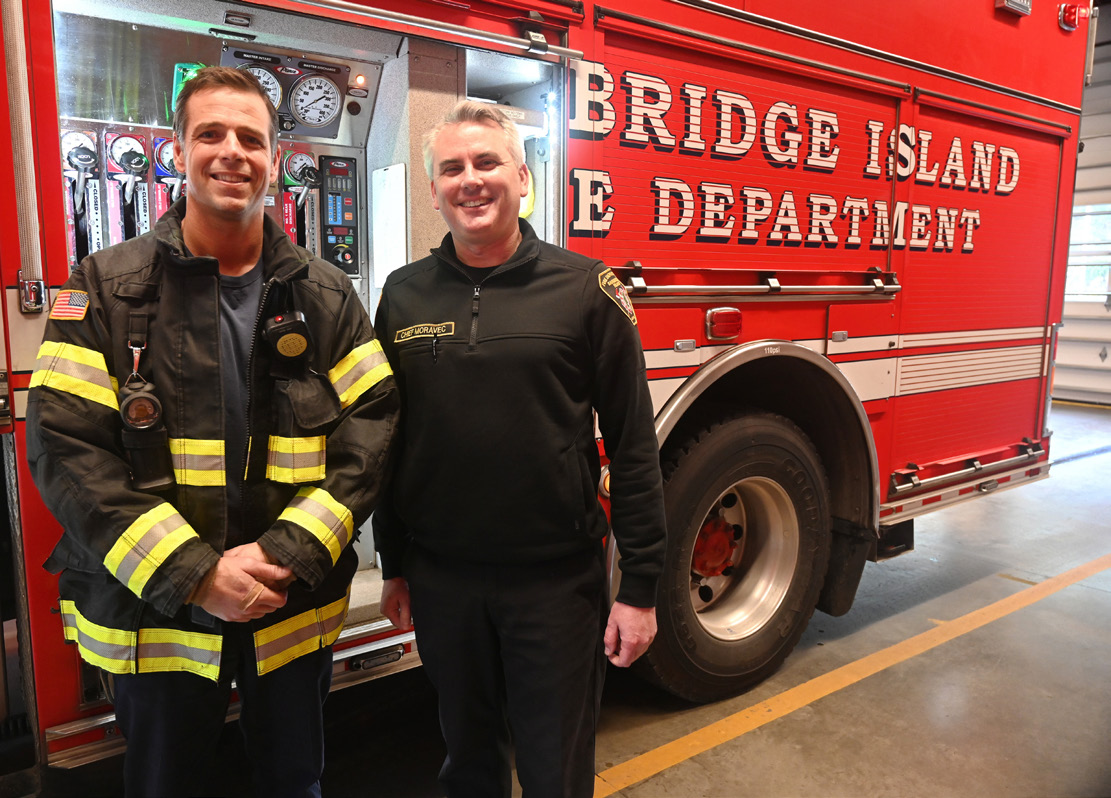
“When folks aren’t training, they’re training,” BIFD Chief Jared Moravec said.
“And then after they train, they’ll train a little bit more.”
Moravec’s crews sometimes run through real-world simulations at the Phelps Road fire station’s concrete training tower or pull hose on Winslow Way late at night. Everyone participates in such dramatic, hands-on drills. But because of the department’s tiered response system, more banal, day-to-day responsibilities can differ between firefighter/EMTs and firefighter/paramedics. Tully and his fellow EMTs are classified as Basic Life Support (BLS) and dispatched on all calls. Meanwhile, paramedics like Korey Abercrombie respond only to more serious Advanced Life Support (ALS) calls, such as cardiac arrests.
“My days are spent waiting for them to call me,” Abercrombie joked. On this Friday, while waiting, he was deftly intubating a mannequin with various video laryngoscopes. The laryngoscopes’ small cameras give him a better view of the throat and airway than their manual predecessors. When not on calls, he often reviews such medical equipment to determine what should be stocked on BIFD ambulances.
Down the hall from Abercrombie and his mannequin, firefighter/EMT Ronnie Saez sat in Station 21’s kitchen—one of the best places to observe the strange mix of mundanity and intensity that characterizes a firefighter’s life. Throughout the day, on-duty crew members in their navy-blue uniforms grab coffee and rummage through the fridge. Each night, Morevac assigns a crew member to cook dinner; the whole crew splits the cost. Occasionally, someone runs out for ice cream.
“Sometimes everyone gets a call the second we sit down,” Saez said of station dinners. “But we try.”
Saez is a “probationary firefighter,” which means she’s been a full firefighter with BIFD for less than a year. She worked a variety of corporate jobs before a friend recommended wildland firefighting. Her first deployment changed her life.
“I was like, ‘I love this work,’” she said. “This is way more in line with who I am as a person, my athletic background, things like that.”
Plenty of former athletes are drawn to firefighting, which is intensely physical work. In fact, Moravec described his crews as “essentially paid professional athletes.” A key aspect of day-to-day station life is maintaining the ability to carry hoses or ladders while wearing 75 pounds of gear and breathing a finite bottle of air. To keep up their strength, Saez and her crewmates spend time in the gyms attached to each station or play Ultimate frisbee, pickleball or other sports. A surprise to some laypeople is that firefighting requires not just physical strength, but mental.
“Our men and women are responding to scenarios that are people’s worst days,” Moravec said. “They’re being put into very high-stress scenarios that require very quick decision making…It takes a special kind of person that not only wants to do that but is able to manage that themselves.”
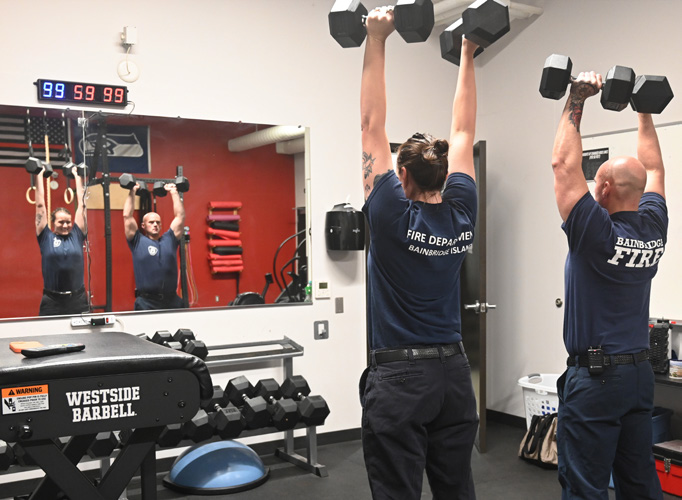
But even the most emotionally intelligent firefighters still have to take care of themselves if they want to be at their best during stressful calls. On-duty crew take midday naps and longer rests in the station’s bunk rooms, eat well and tend to their mental health needs with yoga and grounding practices.
Dag Liljequist, who sees a therapist every four weeks for what he calls “preventative maintenance,” said the fire service hasn’t always recognized mental health as a priority. He welcomes both the small changes—like gentler station lights that aim to reduce the “startle syndrome” of nighttime calls—and the big ones.
“On the whole, the fire service is talking about [mental health] much more openly,” he said. “You go to conferences; there’s discussion about it. It’s not all just fighting fire and doing cool stuff. It’s taking care of each other.”
Liljequist and Saez are both Bainbridge natives—Bainbridge High School graduates whose family and friends still live on the island. They often know the people who call on them for help, which adds a unique dimension to the mental load of firefighting.
Still, Liljequist said, as hard as it is to see loved ones on the job, “the comfort that a lot of these individuals feel when they recognize someone from the department coming to help them—it outweighs that burden of being a responder in your hometown.”
More broadly, there’s no doubt that being a firefighter is well worth the physical, emotional and administrative tasks that fill Liljequist’s and his crewmates’ days. All these tasks add up to something powerful: the ability to save lives and serve the community.
“You’re a kid growing up here, and you don’t realize how lucky you are to live where you do,” Saez said. “And then you realize that there’s just so much support that you’ve had in this community, and so many people have held you up. And it’s just super nice to be able to give back to those folks.”