Let the SUN SHINE IN
The Complicated Work of Bringing the Power of Solar to Bainbridge
BY AUDREY NELSON
PHOTOS COURTESY GEORGE ROBERTSON, BAINBRIDGE ISLAND SCHOOL DISTRICT AND LINDSAY MANCHESTER AT ELEVATION FILM PROJECTS LLC AND CITY OF BAINBRIDGE ISLAND
Carbon-free energy by 2040. That’s the ambitious, island-wide goal currently outlined in Bainbridge’s 2020 Climate Action Plan (CAP).
Meaning it is going to take a lot of solar panels, said Laura Rÿser, the city’s climate and sustainability manager.
Between 2014 and 2018, about 53 percent of Bainbridge’s emissions came from residential and commercial electricity use—more than twice the state average of 20 percent. That number, paired with the Washington Legislature’s directive to achieve statewide carbon-free energy by 2045, spurred the city government’s focus on solar.
Rÿser noted that solar became attractive, especially for energy-conscious islanders, because “it really hits the reducing carbon emissions, but also helping people be resilient in their homes.” Solar is also a cost-effective energy source. In the spring of 2025, Housing Resources Bainbridge received a large state grant to install rooftop solar at its affordable Ericksen Community development. For HRB Executive Director Phedra Elliott, the installation was a no-brainer.
“We come to all our properties, new or already built, with the view of, ‘How can we sustain this physical structure for as long as humanly possible?’” Elliott said. “We want to make sure they’re durable and sustainable and energy efficient and all the things that will keep operating costs down for us and the tenants or homeowners who are having to pay bills.”
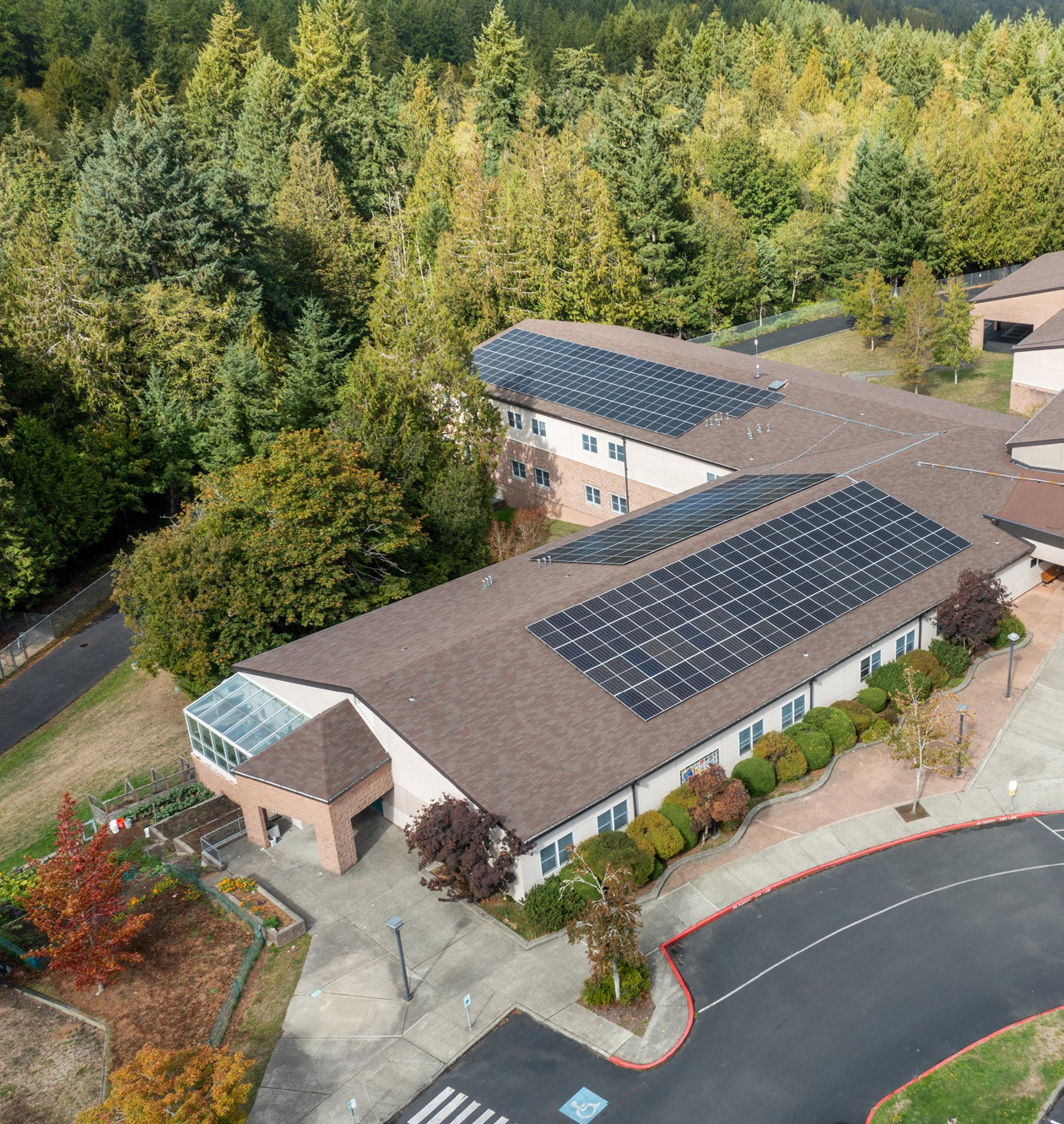
By the time city government adopted the CAP and its solar-related targets, Bainbridge was already punching above its weight with regard to climate action. In 2016, the island explicitly incorporated climate change in the Bainbridge Island Comprehensive Plan. In 2017, the Climate Change Advisory Committee got off the ground, working to provide recommendations for what would eventually become the CAP. And when the CAP was adopted in 2021, several high-profile buildings across Bainbridge had already installed solar panels, including Sakai Intermediate School and City Hall.
“It’s very unique for a small municipality to have a climate action plan specifically and put money behind it and fund it,” said Rÿser, who previously did climate mitigation work for Pierce County. “There’s a story there about the culture of the island and the importance…of supporting environmental work.”
The CAP’s passage provided support and a road map for city government officials and their partners to build on existing solar momentum. Today, those efforts have visibly paid off. New solar panels are cropping up all over the island. As of 2024, 5 percent of private Bainbridge residences had solar. Kitsap Regional Library is installing an array, as are Bethany Lutheran Church and the new Helpline House building. And Woodward Middle School recently won a bid to install panels as a carbon offset for the Ted Spearman Justice Center.
The network of people involved in this solar boom is wide and complex. There is Rÿser, of course, and the city’s Climate Adaptation and Mitigation Office; there are individual homeowners and state legislators; there are emergency preparedness organizations, sustainability groups, solar grant-writing nonprofits and energy providers.
And that’s not an exhaustive list. Rÿser describes much of her job as working across these myriad groups, coordinating their shared goals and limitations. “If I could work 24/7, I would, because there’s enough work to do,” she said.
To fully understand the dynamics of solar transition, and the complicated network of actors that Rÿser oversees, it’s helpful to start with a single case study. St. Barnabas, an Episcopal church just west of downtown Winslow, has long been concerned with combating climate change. The parish’s Stewards of Creation committee focuses on carbon footprint reduction and environmental justice. Accordingly, about two years ago, Stewards of Creation member George Robertson decided to look into putting solar panels on St. Barnabas’ roof.
“I went to the finance committee at the church and said, ‘We really want to do this,’” Robertson said. “‘Is there any way we can afford to do it ourselves?’ And they looked at it and said, ‘It’s a great project, we’d like to see it done, but there’s no way we have money to do that. So, if you can find the money, we’ll do it.’”
Cost is a common barrier to installing solar—particularly for smaller residential projects that might require loans. When it comes to solar, “there’s not a lot of options for financing, for lending,” Rÿser noted. “You can’t compare and try and get a better rate when you don’t have options.”
Even for larger, nonresidential projects, potential federal funding has been a no-go since 2024. Luckily, state solar money is still plentiful. Robertson quickly contacted Olympia Community Solar, an organization that provides grant support services to nonprofits installing solar. The group helped Robertson apply for four different grants. In the summer of 2025, Washington’s Department of Commerce awarded St. Barnabas a $161,896 Clean Energy Community Grant. (Both Housing Resources Bainbridge and Bethany Lutheran Church benefited from the same grant program earlier that year.)
With the help of the grant, St. Barnabas will install 127 solar panels on the sanctuary, office and parish hall buildings.
“Some of these panels, when you walk up to the entrance of the church, are going to be visible,” Robertson said. “Everybody who comes to our church will know these are people that care about trying to do something about the climate crisis.”
Over their 30-year expected lifespan, the panels will provide about 83 percent of the church’s electricity needs. In addition to reducing its carbon footprint, St. Barnabas members will save about $280,000 in electricity costs over the same 30-year span.
St. Barnabas is one of Bainbridge Prepares’ Disaster Hubs, as well as a city-designated warming center. The new panels guarantee a resilient energy source for the church in these potentially lifesaving roles, and contribute to St. Barnabas’ spiritual goal “of caring for creation more effectively,” Robertson said.
Port Townsend’s Power Trip Energy was scheduled to install the panels in late February and/or early March 2026. Robertson estimated that the array will be finished and activated in time for a ribbon-cutting ceremony in April. A week later, Olympia Community Solar will hold a workshop at St. Barnabas—to discuss the church’s installation and educate community members interested in residential solar.
Olympia Community Solar is staying busy. It will also partner with Laura Rÿser and the city of Bainbridge as part of the 2026 Solarize campaign. By operating across different municipalities, Solarize decreases the cost of installing residential solar; Rÿser described it as a “matchmaking program.” “You just connect interested people with contractors who can do an assessment of their home, and then they can run with it however they want,” she said. Since educating homeowners and promoting solar subsidy programs are two of Rÿser’s—and the CAP’s—main goals, Solarize is a natural fit.
This year, Rÿser will also be spearheading a revision of the CAP: soliciting community feedback, measuring impact, and making sure the plan’s concrete goals are achievable. Specific dates and numbers may change. But Bainbridge’s general push for clean energy will not.
“Everybody, in my opinion, needs to be connecting and syncing and aligning our actions and strategies, because we all have a very similar goal,” Rÿser said.
That goal, of course: more solar, less greenhouse gas.