GEMS ACROSS THE WATER
Bainbridge Nonprofit Spreads Hope and Healing to Post-Soviet Countries
BY DANA THOMPSON | PHOTOS COURTESY PARTNERSHIPS FOR NATURE
Living on Bainbridge –surrounded by water, forests, trails and wildlife—is to be immersed in nature. IslandWood, Bloedel Reserve and Bainbridge Island Metro Park and Recreation District, with their extensive environmental and educational outreach programs, further deepen this connection by encouraging locals and visitors alike to actively engage with the natural world.
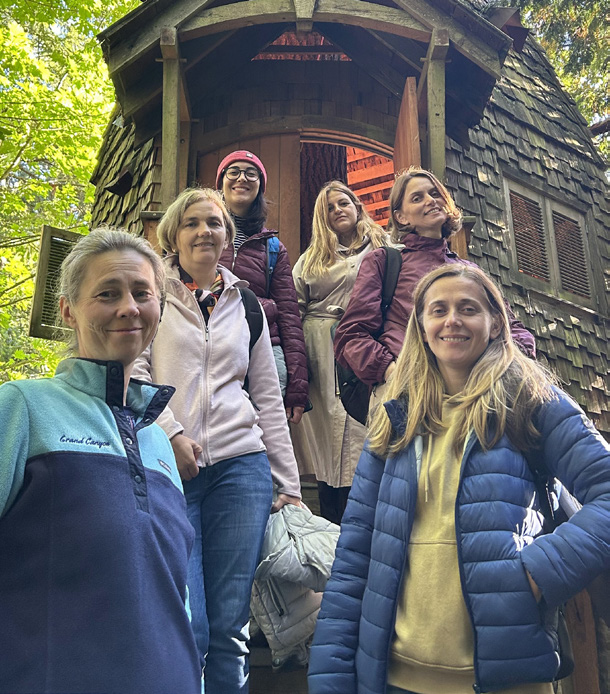
Thanks to Bainbridge-based nonprofit Partnerships for Nature (PN), whose mission is “to build collaborative relationships to enhance nature education, healing, restoration and conservation,” this mindful approach is now taking root throughout several countries of the former Soviet Union.
Although common in the U.S., environmental education programs were rare in countries emerging from the Soviet Union, despite the existence of highly suitable platforms in large, well-developed botanical gardens in most major cities.
“Botanical gardens are places of rich knowledge about local plants, restoration and conservation, and yet, traditionally, these scientific institutions were mostly inaccessible to the public,” said Bainbridge resident Ariadna Reida, a long-time environmental educator and PN co-founder and board vice-president. “The goal of Partnerships for Nature is to support botanical garden staff and shift how they communicate with their public, helping them build connections between visitors and the natural world.”
Founded in 2020, the volunteer-run PN evolved from a series of successful environmental exchanges organized by co-founder and Board President Tony Allison, a former educator at Washington Park Arboretum with extensive experience working in post-Soviet countries. From 2010 to 2019, these exchanges connected scientists and educators from eastern Russia with institutions in the Pacific Northwest, including IslandWood and Bloedel, where participants gained hands-on experience in volunteer engagement, environmental education and interpretive techniques.
“This work is like spreading gems across the water and about sharing ideas,” said Karen Salsbury, another island resident and PN co-founder, who has helped lead exchanges and served for years as senior faculty for natural history education in IslandWood’s graduate program. “Even simple activities can help introduce people to nature in a meaningful way and teach the next generation to care for our environment.”
Currently, PN has shifted its focus to Armenia, the Republic of Georgia and, especially, Ukraine. Building on early endeavors through continued exchanges and workshops, PN focuses on connecting botanical gardens from these countries with the financial and intellectual resources necessary to create successful programs for their own populations.
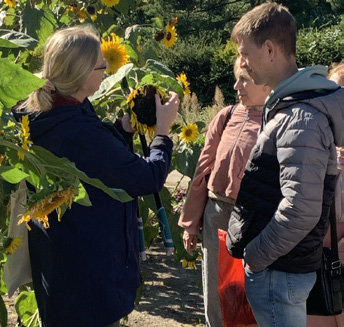
Nowhere has Partnerships for Nature’s work had a more timely and profound impact than in Ukraine. Immediately after Russia’s invasion in February 2022, the organization stepped in with emotional and financial support. Already scarce funding had been redirected to the war effort, even as many Ukrainian botanical gardens became oases of respite and recovery for thousands of displaced, traumatized citizens.
“When the war started, it hit everyone really hard and many people, including employees, left,” said Alla Gnatiuk, a senior scientist researcher at Kyiv Gryshko National Botanical Garden. “Once people started returning, everyone was different, and we wondered how the botanical garden could help.”
Today, Ukraine’s botanical gardens have become symbols of hope and resistance , reminding people that beauty still exists despite the ugliness of war.
PN fundraising, with significant support from Botanic Gardens Conservation International (BGCI), enabled 10 botanical gardens across Ukraine to retain staff, keep facilities open and preserve valuable plant collections. Recent mini-grants have been earmarked for new programs unique to individual gardens, for things such as the purchase of basic planting or art therapy supplies or, as in Odesa Botanical Garden, construction of needed restroom facilities for their expanded education programs for children.
Continued PN grants to Ukraine will support virtual and physical training in both environmental interpretation and therapeutic horticulture, the intentional use of plant-based activities to promote healing. A six-week pilot course in January 2026, “Introduction to Therapeutic Gardening from Botanical Gardens of Ukraine,” was offered free of charge to 19 professionals from across Ukraine. The ambitious initiative was a collaboration between four Ukrainian botanical gardens, with the tangible goal to broaden the practice of therapeutic horticulture to heal and foster resilience in Ukraine’s citizens.
“Integrating therapeutic horticulture into our education programs has allowed us to better reach vulnerable groups—children with disabilities, veterans, military families and the elderly—helping us foster peace and healing for those experiencing both physical and emotional trauma,” said Gnatiuk who, along with her colleagues at Gryshko, developed a detailed teaching manual in Ukraine and is one of 10 Ukrainians to receive a therapeutic horticulture certificate through the North Carolina Botanical Garden’s online curriculum.
These, perhaps, are the most powerful seeds blossoming out of PN’s work: a network of collaborating overseas partners and the creation of vibrant programs and activities that provide respite, hope and connection with the natural world. “Partnerships for Nature ’s success,” Allison said, “ultimately, will be the success of our partners.”
To learn how to support Partnerships for Nature’s work, visit partnerships-for-nature.org.