
Welcome Home
New Ericksen Community Apartments Build a Foundation for Sustainable Affordability
BY CONNIE BYE | PHOTOS BY DINAH SATTERWHITE
Ericksen Community, an 18-unit apartment building for qualified renters, welcomed its first residents in July, taking a big step toward meeting the need for affordable housing on Bainbridge Island.
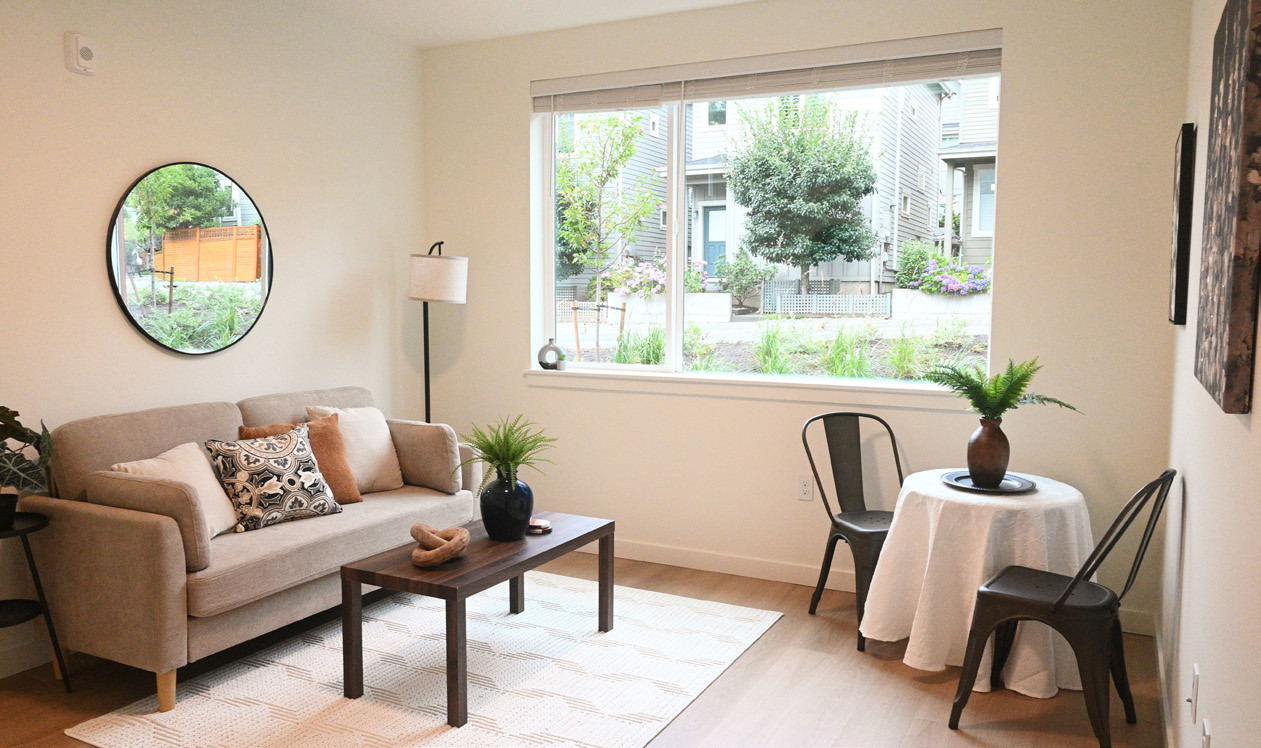
The location, 680 Ericksen Avenue, is ideal—on a bus route and within walking distance of the ferry, grocery and other stores and Helpline House, Housing Resources Bainbridge spokeswoman Tamar Kupiec said in an email interview.
With all such projects, the biggest obstacle was the land cost. But a couple offered to sell the property to HRB for “roughly half its market value,” Kupiec said. The benefactors asked to remain anonymous.
Work began in June 2025, with the apartments ready for occupancy in late July 2026.
The result: a sleek three-story building that hugs the once-rugged hillside a few blocks north of Winslow Way.
“It’s a simple, overall building form,” said architect Charlie Wenzlau. “One goal was to emphasize the front of the building, to create a welcoming entry.”
Another goal: optimize the number of homes that the somewhat small lot could handle. “We wanted to make the most of the property,” he said. His firm, Wenzlau Architects, focused on site design and landscaping, knowing that the new building would affect the esthetics of the neighborhood, which includes homes, another apartment building, offices and other businesses. “We wanted the design to comfortably fit into the neighborhood and make it a welcoming home for the people who will live there.”
Such apartments are important for “housing stability,” Kupiec said. “Low-income families tend to move more frequently, often under duress and without improvement in living conditions. We often say that a safe and affordable home is the foundation on which to build a life. When you’re not worrying about where you are going to live, you can devote time and resources elsewhere, perhaps by focusing on education, tending to health and well-being, volunteering and investing in community, or building relationships with teachers, doctors, friends and neighbors.”
Kupiec noted that the project met the Evergreen Sustainable Development Standard, which requires healthy building materials and high-quality stormwater management as well as energy and water efficiency, and which is required for all projects that receive support from the Washington State Housing Trust Fund.
To select the occupants, HRB reviewed the 452 applications on its waitlist in the order they were received, Kupiec said, checking for households that met the income requirements and other criteria. Ericksen Community residents must earn no more than 50 percent of the area median income, as calculated by HUD, or have an active Housing Choice Voucher.
They also must meet the criteria for a particular unit. For example, HRB wouldn’t place a two-person household in a three-bedroom apartment, Kupiec said, and they must meet “the special requirements of our funders,” for example, some homes are reserved for senior citizens, others for people fleeing domestic violence.
“Rents, at Ericksen and our other properties, are set by our funders to be affordable to households at the specified income level for the apartment,” Kupiec said. HRB expected that Ericksen Community rents would be about $1,215 for one-bedroom apartments and $1,685 for three-bedroom units. “However, they will be lowered to reflect a utility allowance,” she noted.
“The lobby is spacious and will include a bench crafted by BARN volunteers with wood from trees harvested on site; these alder trees were also used for decorative wood panels outside the apartment doors,” Kupiec noted. “There is a small terrace outside the entry to the lobby with a lovely garden with a water feature that is part of the overall landscape design.”
With completion of the Ericksen Community, HRB owns and manages 73 apartments on Bainbridge, Kupiec said. “HRB is also the nonprofit partner in the 48-unit Island Terrace, a Low-Income Housing Tax Credit property. We are not the manager at Island Terrace.”
HRB’s average rental tenancy had been nearly 6 years, about twice the average for market-rate apartments, Kupiec said. “However, we just added 13 apartments at the Oliver to our inventory. This sudden influx of new renters together with the newcomers at Ericksen will affect that average.”
Wenzlau, who previously served on the HRB board, said the design for the Ericksen Community apartments could be modified for use on other lots. “The basic layout is very efficient. It demonstrates how you could do small, infill housing throughout the community.”
Next up for HRB is Finch Green, 22 small, single-family homes with two to four bedrooms that will be built on acreage donated by Bethany Lutheran Church. These homes will be sold to qualified buyers. Completion is expected in late 2027, Kupiec said.
“HRB is a community land trust. A defining feature of this model is permanent affordability,” Kupiec noted.
“With rentals, that’s straightforward—our government funders set our rents to be affordable to households at certain incomes. In comparison, most affordable rental housing has limited affordability requirements, often 30 to 50 years.
“With homeownership, it’s a little more involved. When we sell the home, we do not sell the land underneath. Instead, we lease it to the homeowner. The ground lease is what enforces permanent affordability. When an owner decides to sell, the lease requires that they sell to another income-qualified buyer at an affordable price. Even with the limit placed on appreciation, homeowners earn equity.
“Permanent affordability is more sustainable,” Kupiec said.