
Spotlight on Chris Walker
By Luciano Marano | Photos by Annie Graebner
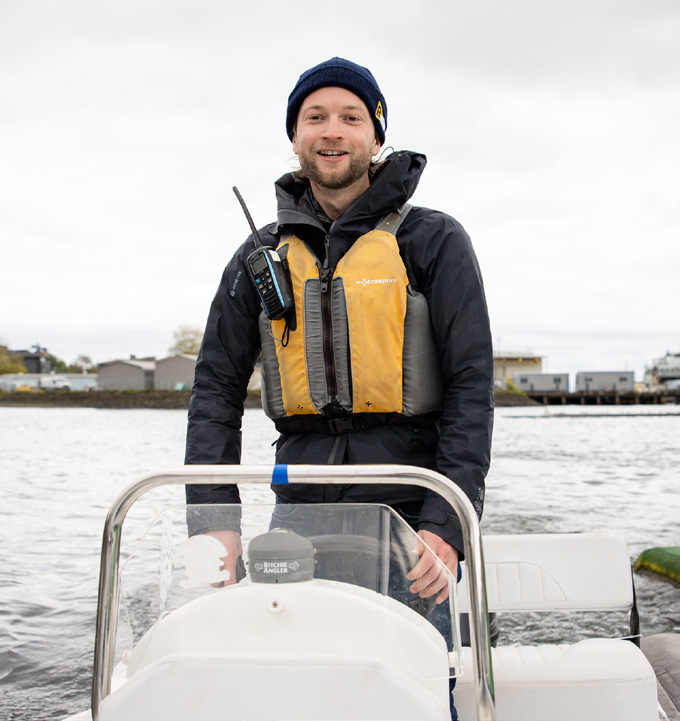
High school sailing coach Chris Walker has been involved with Bainbridge’s competitive youth sailing program at every level, stretching back to his childhood on the island.
“I have a lot of great memories from those early days,” he said. “I’d volunteer in the mornings helping with the beginner classes, then take the advanced classes in the afternoons. The head instructor at the time used to ‘pay’ me in king-size candy bars at the end of each week, which felt like a pretty amazing deal at the time.”
Tell us a little about yourself and how you came to be a sailing coach.
Since high school, I’ve basically taught sailing every summer in some form. In college at Western Washington University, I worked as a student instructor teaching sailing PE classes and summer camps. After moving to Seattle, I continued that alongside my day job as a software engineer, working as the lead sailing instructor at Mount Baker Rowing and Sailing, and now I’m the Bainbridge head coach.
What do you see as the sport’s primary appeal?
It can be so many different things depending on what you want out of it. A lot of my friends have zero interest in racing, but they love coming out on a calm, sunny day, packing snacks and just relaxing on the water. And then there’s the other side of it—I have an alert set on my phone for small craft advisories, and when the wind picks up I’ll take out a tiny one-person boat and see how fast I can go. Those sessions usually involve spending a fair amount of time upside down, but that’s part of the fun.
Do most of the team members come to the sport with some sailing experience or are they primarily true novices?
Right now, most come in with some level of sailing experience. They don’t necessarily need to have racing experience, but they do need to be comfortable handling a boat. With only one coach, it’s tough to teach the fundamentals of sailing and more advanced racing tactics at the same time, so having that baseline really helps us run effective practices. For kids who are interested, local programs, like the Parks & Rec sailing camps and the Port Madison Yacht Club’s junior sailing program, are great ways to build that foundation. They’re accessible, affordable and a fun introduction to the sport.
Are there certain characteristics that make somebody a naturally gifted competitive sailor?
Sailing is a bit different from a lot of other sports because there isn’t one ideal body type. We really benefit from having a range of sizes and strengths. On lighter wind days, it can actually be an advantage to be smaller and lighter, whereas in heavier wind, having more size and strength helps keep the boat under control. Because of that, we’ll often mix and match sailors, depending on the conditions, to get the right balance for the day.
How would you describe your coaching style?
I try to focus on making the team be the best version of itself, both on and off the water. Of course, we want to be competitive and win, but it’s just as important that we’re having fun and building strong relationships and good memories along the way.
What are the best and worst parts of working with kids?
I feel like I’m supposed to say something like, “Watching them grow, improve and succeed is incredibly rewarding,” and that is true. But if I’m being honest, the best part is probably annoying them. I love giving ridiculous answers to their questions, making terrible jokes or dropping bad references just to get that exasperated reaction. It makes my day every time. I definitely understand now why my dad thought it was so funny to annoy me when I was a teenager.
As for the hardest part, it’s when you have a lot of really talented sailors and only a limited number of spots at the top level. We’ve got a strong group this year, and it’s tough having to tell someone who’s sailing really well that they just missed the cut, even though they absolutely have the ability to compete there.
Oh, I had also forgotten just how moody teenagers can be sometimes.Cool Down