Something New Under the Sun
Stargazing on Bainbridge Keeps Getting Better
By Christy Carley
Photos by Dinah Satterwhite
Battle Point Astronomical Association’s chief astronomer is, by trade, a veterinarian. Now retired, Chuck Wraith said that what attracted him to veterinary medicine isn’t so different from what attracted him to astronomy: you get to do a bit of everything.
Wraith said that at the time he was working as a vet, “It was kind of like the Wild West…You did surgery, you did anesthesia, you did radiology.”
And astronomy?
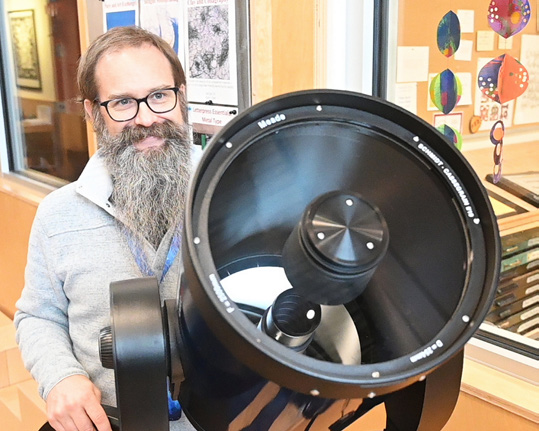
“It’s physics. It’s optics. It's engineering. You name it.”
BPAA’s tagline is “igniting passion for science through the lens of astronomy.” While all of its board members love learning about space, they also see astronomy as a jumping off point to promote curiosity about a number of scientific fields: from 3D printing parts for telescope mounts to using a spectrometer to look for elements in the sky. And they haven’t forgotten about the arts, either.
Deborah J. Milton, BPAA’s artist in residence, wandered over to the Battle Point Observatory one day while walking in the park. Noticing the walls of the entryway were “drab” she offered to paint a mural, explaining that she had also painted murals in a hospital before. The result was a wall and doorway bursting with color and wonder.
Now, Milton hosts paint nights inspired by planetarium shows––attendees paint the Milky Way, nebula or the moon.
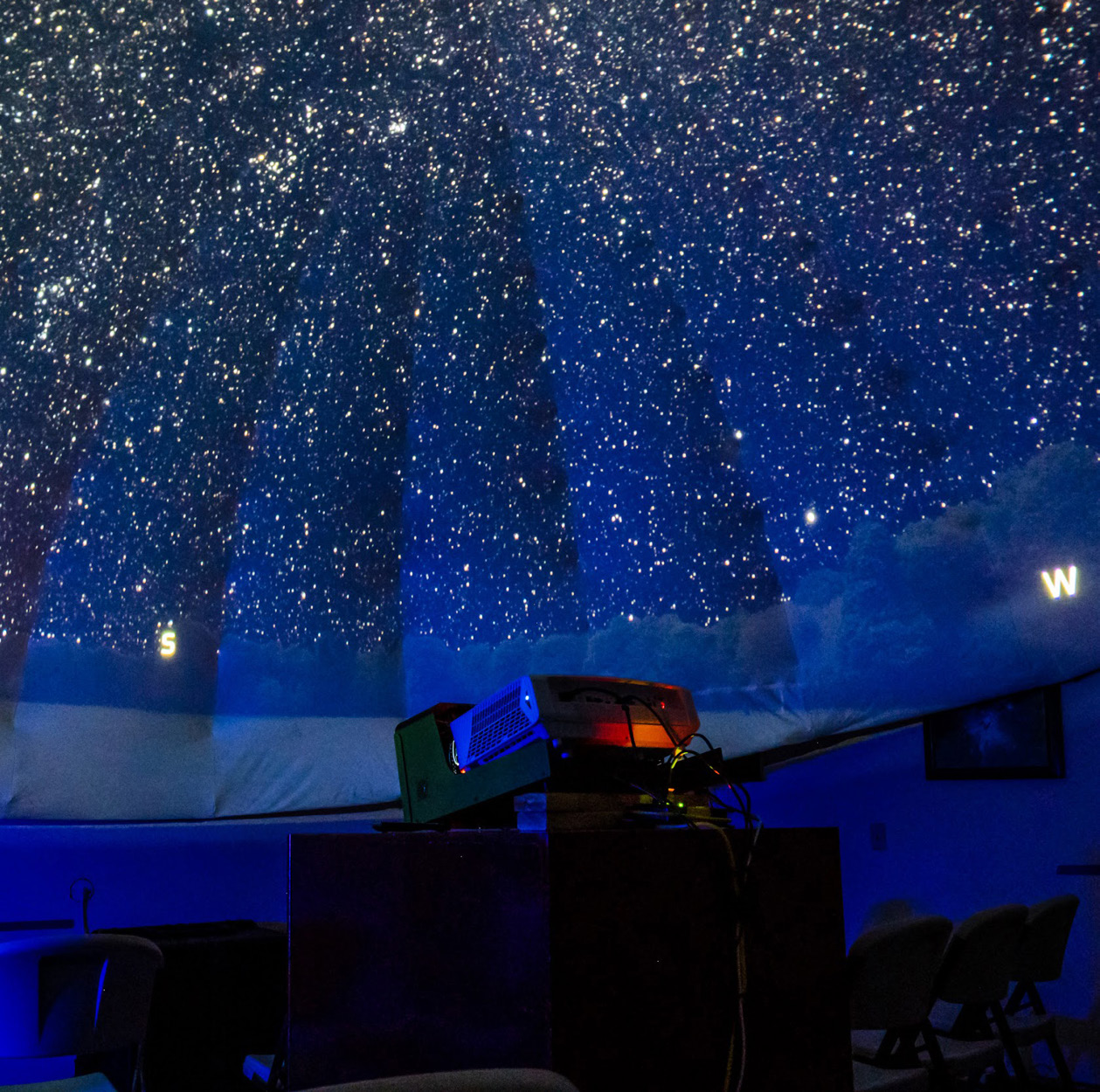
Paint nights are just one example of how BPAA has amped up its programming in the past year. In May 2025, the organization hired Eleanor Uyyek, a master’s student in aerospace engineering, as its programming coordinator. Uyyek has worked with schools around Kitsap County to organize field trips to the observatory and has helped host walk-in planetarium shows on Saturdays that are open to the public.
Wraith is also working on starting an astrophotography group so people can learn more and share their knowledge about the science––and art––behind the capture of cosmic images. Several members of the association have done astrophotography projects before––with exposures that span several days and require programming one’s equipment to track the object being photographed as the earth rotates.
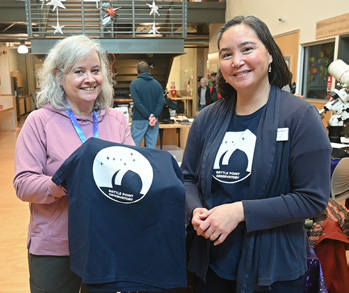
Efforts to combine art and science are one way to bring different minds together. And in astronomy, bringing different minds together is essential. NASA even harnessed the ancient art of origami to make sections of the James Webb telescope foldable in order to fit it into the rocket from which it was launched into space.
Erin Howard, the education officer and planetarium director for the observatory, said that they have been talking with Milton about expanding art offerings at the planetarium, potentially incorporating programming around poetry or storytelling. Currently, Howard runs a women in STEM book club through BPAA, which focuses on the stories of women whose contributions to math or science were historically ignored.
Howard works remotely as a research scientist for Vera C. Rubin Observatory in Chile, operating and testing software. Their interest in astronomy was sparked –– like that of many members of BPAA –– by witnessing an exciting space-related event. In their case, it was watching the Hale-Bopp comet in the ‘90s from their parents’ backyard. Howard started an astro-physics degree right out of high school but ended up changing course. It wasn’t until 2015, when several scientists affiliated with the Rubin Observatory came to give talks in Bremerton, Howard’s hometown, that they decided to go back to school and pursue work related to astronomy.
“I know a lot of people focus on kids,” they said. “But there's so many adults out there who think they missed out on their dream. And if they just meet one person telling them the right thing at the right time, it can change their trajectory, like it did for me.”
More at bpastro.org