Rites of Passage
WSF Special Services Enhance and Expand the Riders’ Journeys in Unexpected Ways
The feeling of the ride—the dynamic scenery, distinctive atmosphere and the sense, however fleeting, of being part of something bigger than ourselves—is as much a part of the experience as the eventual destination itself.
Whether it’s your first time onboard, a vacation bucket list item, or something you have gone through twice a day, five days a week for years, riding with Washington State Ferries leaves an indelible impression.
So much so that a whole lot of people over the years have chosen to take advantage of the lesser-known special services provided by WSF to celebrate major milestones while aboard, including birthdays, anniversaries, weddings and even memorials.
It's an unconventional setting, perhaps—but you can’t beat the view.
“Ferries are an important part of many people’s lives and stories, and holding memorials and weddings onboard is a way we can give back and honor them in a uniquely Washington [and] traditionally maritime way,” explained Zale Noah, WSF Customer Program Coordinator. “The incredible deck crews often go above and beyond to provide support and meaningful service because they see firsthand how much families appreciate having ceremonies onboard.”
Birthday, anniversary, and retirement parties are fairly casual affairs and require no advance registration.
WSF policy says passengers are always welcome to bring cake and other preprepared food aboard, although outside catering is not permitted and alcohol must be purchased from and consumed within the galley. Also, due to fire safety regulations, open flames, including (sadly) birthday candles, are not allowed.
Otherwise, have a ball!
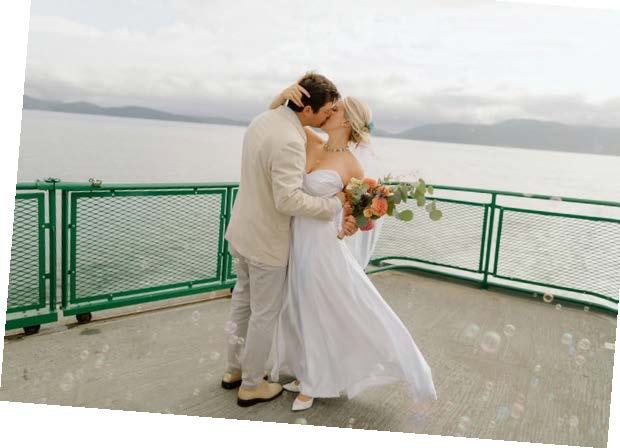
No advance arrangements are necessary to host a wedding onboard either, though it’s strictly B.Y.O.O. (Bring Your Own Officiant) as WSF captains are not allowed to perform the ceremony.
While it may seem an unlikely locale to some, for others it’s the ideal spot to mark an occasion or begin a new chapter of their lives.
Noah said that the Puget Sound area typically has special significance for the people who choose to hold ceremonies. “Whether they have a maritime hobby or profession, a cultural connection to the water, have lived or grown-up in the area, ride the ferries as part of their daily routine, or are simply ferry enthusiasts, all are welcome to sail together and use these services.”
Keep in mind, however, that it’s public transportation, meaning that you could wind up sharing the space with a few more guests than you planned for. But then again, that’s also part of the ferry experience.
“Most riders wanting to hold a special service onboard understand that WSF is a public transportation system,” Noah explained, “so riders not involved with the memorial or wedding will be on the sailing, and certain requirements are in place for this reason.”
For memorials, ashes must be placed in a certified biodegradable container (sometimes called a journey urn) which dissolves quickly in water but will stay intact when initially released from the ferry. A floral tribute may also be released, but it cannot have plastic, wire, ribbons or other non-biodegradable materials.
Each vessel's captain has the final say on whether a memorial can take place, and it may also be canceled due to bad weather or other operational issues. If that should happen, the memorial may be moved to another vessel, rescheduled or refunded. For each memorial there is a $150 dollar fee, and tickets for all passengers are also required.
Only one memorial is scheduled per day, per route and not all routes in the WSF system can host memorials, but they can be scheduled on the sailings between Anacortes/Friday Harbor, Anacortes/Orcas Island, Edmonds/Kingston, Mukilteo/Clinton, Port Townsend/Coupeville, Seattle/Bainbridge Island and Seattle/Bremerton.
According to Noah, WSF holds an average of 185 memorials onboard per year and 2025 has been its busiest year yet, with 246 memorial services already held or currently on the schedule.
Requirements also include holding memorials on sailings outside of peak travel times to minimize delays as well as (slightly less officially) dressing for the season.
“People understand,” Noah added, that “because this is Washington, to prepare for any weather on the day of a special service, especially since dates are usually finalized at least a week before a service.”
Regardless of whether you’re on the boat to say goodbye or I do, it’s still the Pacific Northwest, after all.
Some particularly special events—despite the best laid plans—cannot be prearranged. While the ferry is often a site where lives are eulogized and commemorated, a few lives actually begin there.
WSF spokesperson Brian Vail said that although there is no official comprehensive list of babies born on WSF vessels and that it is a relatively “rare occurrence,” it does occasionally happen.
Vail stated that WSF crews are trained for on board births, along with many other health-related issues. “They go through emergency response, first aid and medical training to be prepared for these situations. We also count on our community to support our crews, as doctors, nurses and other medical professionals are called to help when these incidents happen.”
One medical professional, Bainbridge Island resident and University of Washington interventional radiologist George Soltes, found himself in that exact situation during an early morning sailing to Seattle on the MV Puyallup back in October 2014.
“I was sitting in the galley, just wearing normal civilian clothes,” he recalled. Then, an announcement requesting assistance from medical professionals onboard brought Soltes, another doctor (a pulmonologist) and a nurse to the Second Mate’s office to find a delivery in progress.
“[She’d] been heading to Seattle to have the baby, but it didn’t wait,” Soltes said.
“Honestly, the nurse did a lot of the actual delivery,” Soltes said. “The baby was born in the Second Mate’s office on the ferry at about 6 a.m., right as we were docking.”
The newborn’s father, who waited just outside the office with the couple’s other small child, was relieved and thankful for the assistance—that is until Soltes informed him of a little-known birth-related maritime custom.
“I told him that it’s traditional when a baby is born on the ferry to name the baby after the ferry, so he’d have to name his daughter Puyallup.” The family ultimately decided to ignore this ferry “tradition,” which Soltes readily admitted he made up on the spot, opting instead for Zoe.
Paramedics came aboard in Seattle to transport the mother and newborn, both perfectly fine despite the unexpectedly eventful crossing, while Soltes and the rest of the impromptu delivery team went about their days as normal.
“I still had to go to work,” Soltes laughed.
Rumors persists that anyone born on a ferry receives free rides for life. But, according to Vail, that’s only sort of true. “Under current policy all children receive free public transportation throughout Washington until they turn 19 years old,” he explained.
After that: Pay up, kid!
“To my knowledge,” he said, “a child born on a ferry has not received lifetime passage on our ferries.”
But they can always return to celebrate their birth at the spot where it actually happened, no reservation required.
>> Those interested in arranging an event on board a WSF ferry should call 206-515-3464 or visit the Special Occasions section of wsdot.wa.gov to view the complete list of requirements and submit a request.