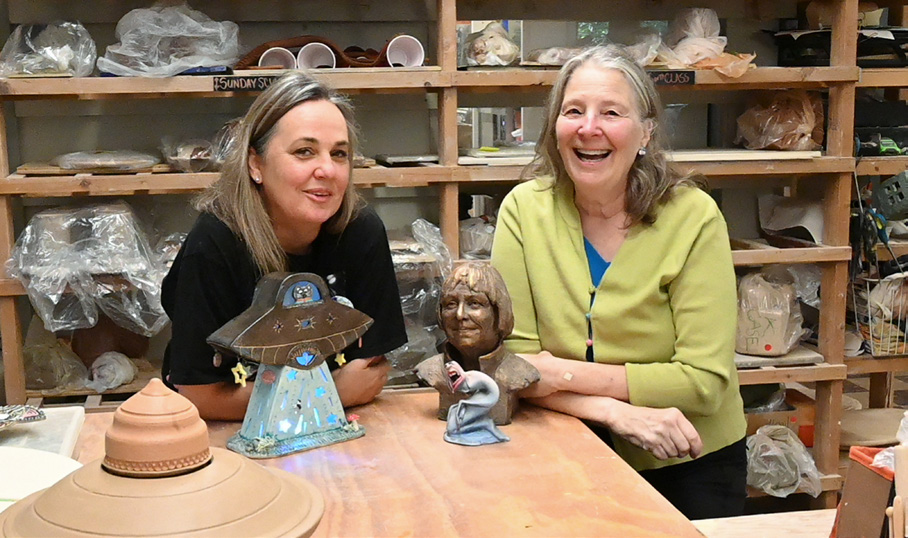
Tucked away in the forest, the Eagledale Pottery Studio has quietly nurtured artists and community for nearly a half century. What began as a modest series of art classes in the 1970s has grown into one of the island’s most beloved creative spaces—a place where curious newcomers, beginners and lifelong potters gather to shape more than just clay.
Eagledale’s roots trace back to around 1976, when the first pottery classes were offered at a small, funky art center. Over the decades, it has become part of the Bainbridge Island Parks and Recreation District and evolved into a fully equipped ceramics facility serving more than a thousand students a year. Instructors and long-time students describe it as a happy place, where creativity and camaraderie go in hand.
“We’ve built a real community here,” said Debbie Fecher Granstad, who teaches figurative sculpture. “Never say oops, always say interesting—that’s my motto.” Her playful advice captures Eagledale’s spirit: experimentation, resilience and joy in the creative process.
The building itself has a storied past—it was reportedly a radio station during World War II and some instructors even joke that it might be haunted. But what truly animate the space are the people who fill it each day. Teachers, students and volunteers have transformed it into a vibrant hub that welcomes everyone, from preschoolers shaping their first pinch pots to seasoned artists refining advanced techniques.
Classes covering hand building, wheel-throwing and sculpture are held seven days a week. There are youth programs, teen and adult classes, adaptive sessions for people with disabilities and new offerings for seniors. Instructors estimate that there are now about 10 teachers—double the number from the program’s early days. Each brings a distinct focus: Some specialize in sculpture or wheel work, others in Raku firing or hand building. Together, they’ve built a curriculum that balances technical skill with creative freedom.
“People come here because of the community,” said Elena Wendelyn, who teaches wheel.
For a community studio, Eagledale boasts remarkable equipment. The facility includes several electric kilns, a top-of-the-line cone 10 gas kiln—rare even among professional studios—and soon, a new Super Raku kiln for large-scale firings. The gas kiln, which cost over $25,000, was acquired through grants and community donations spearheaded by a former instructor before her retirement. “You can actually touch the side of it when it’s thousands of degrees,” Wendelyn said.
Raku firing, a favorite among students, involves removing pieces from the kiln while they’re still red-hot, placing them into containers of combustibles, and letting smoke and fire create unpredictable, iridescent finishes. “It’s dramatic and beautiful,” said Wendelyn. “That’s what people love—you never quite know what you’ll get.”
While Eagledale is known for its technical excellence, instructors emphasize that the studio’s real value lies in its openness. “We’re not a production space,” Fecher Granstad explained. “We’re a teaching studio—for people who want to learn, experiment and find joy in the process.” That ethos has made Eagledale a welcoming gateway for artists who have gone on to open their own studios around the island.
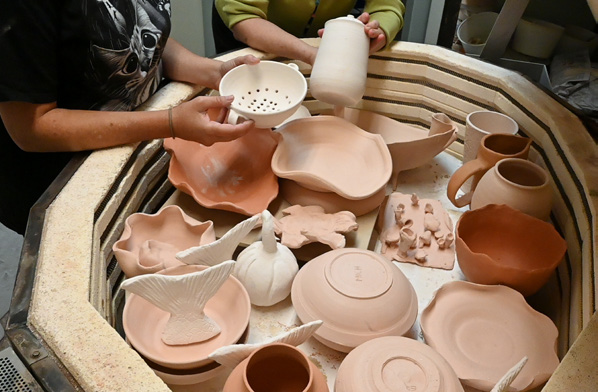
Many participants have been attending classes for decades, forming deep friendships and artistic partnerships. “Between staff and students, we’ve got a really good run of people right now,” said sculpture and hand building instructor Heather Polverino. “It feels so good.” The sense of belonging is so strong that even through economic downturns or community changes, Eagledale has remained a steady source of connection and creativity.
The Park and Recreation Department supports the studio, overseeing operations alongside programs in sports, outdoor recreation and adaptive activities. Despite growing demand—many classes sell out within minutes—teachers are careful not to expand too quickly.
Eagledale’s reputation as “our little secret” is something the instructors wear with pride. “It’s amazing how many people on the island don’t even know we’re here,” said Polverino. “But that’s OK—it’s nice being this tucked-away place where people can come and create.”
Still, they welcome chances to share their story. Whether it’s the glow of the kilns, the chatter of students trimming pots or the laughter echoing through the studio, Eagledale is the embodiment of a grassroots art community.
As Gramstad put it, “Pottery should be a happy place—and this is a happy place.”