FROM VACATION TO FOREVER
A Family of Four Finds its Way to Bainbridge
By Alli Schuchman
Photos by Nick Felkey, Courtesy Cynthia Carpenter
Family Portraits by Annie Graebner
Michael and Christy Boyd’s life—and home—is very much by design. But it started south of here. “I walked into the fitness center, and there she was,” said Michael, recalling the day he met Christy while the two were working at Apple in Northern California.
Six months later, they began dating and eventually moved into a friend’s house in Los Gatos. And five years after that, they got married and bought a house up in the hills where they stayed for the next 11 years, while building their careers and welcoming their two children.
The Boyds’ lives didn’t start to tilt northward until their kids turned 4 and 6. Christy said that their vacations had changed from sitting on a beach while the kids played in the sand, to being able to hike, picnic and explore together. During the summer of 2018, the Boyds drove up to the Pacific Northwest and landed on Vashon. “We just had the best time,” she said. “And we thought, ‘Oh my gosh, this place is incredible. Everything is beautiful.’”
The following year they returned to the area: Lake Sutherland, Whidbey, around the Olympic Peninsula and the Hood Canal. As Christy recalled, they were staying at Alderbrook when Michael launched into his favorite travel game: “I think we could live here.”
They started scrolling through real estate listings on their phones, at first purely for fun. “Like, what would it cost to live here?” said Christy. “What would our lives be like?”
When they began to look more seriously, they were still thinking more about a vacation house. But one thing was nonnegotiable: proximity to SeaTac. Michael was still working for Apple and traveling, and whatever they bought had to be reasonably accessible. They toured cabins on Hood Canal. They looked in Gig Harbor. But the search kept bringing them back to Bainbridge.
The island wasn’t a complete unknown to Michael. Years earlier, when visiting a friend in Seattle, he’d hopped a ferry, biked the island and tucked the place away in the back of his mind. It reminded him of Long Island, where he’d grown up: water, trees, village-sized, a little removed from the city but still connected. Over time, Bainbridge reappeared in casual conversations with Christy, layered onto her own fond memories of visiting family in Oregon.
After deciding on the island, the next step was finding a home. As luck would have it, their house wasn’t even on the market when they first walked through it—virtually. Their Bainbridge agent gave them a video tour a few days before the listing went live and they learned that it had something rare: four bedrooms on the water. They watched the walkthrough, seeing the site, the water and the bones of the structure. Then they made a bold move: an offer before anyone else had a chance to bid. A couple days later the house was theirs.
The following week, the Boyds were in Spokane for vacation when they changed their plans, driving across the state and seeing the house in person for the first time as its future owners. The setting was everything they’d hoped for: wooded, quiet, opening onto the water with a dock below. The house itself? Amazing, they agreed—but mostly for its potential.
“It was very disjointed,” Michael said. The structure had been built in 1978, then fully remodeled around 1999 after a fire. He said that one of the more curious rooms in the house was the primary’s bathroom, an elevated, blue-and-white-tiled space that looked like it had been airlifted from Greece. And throughout, the floor plan made little sense. There was a huge powder room upstairs with nothing but a toilet; a main living room that didn’t properly take advantage of the view; a warren of small, dark and awkward rooms and hallways. The supposed front entry didn’t function as an entry at all and driving down the driveway lead straight into a wall.
Michael and Christy started conservatively, thinking they’d make just a few changes: redo the dated kitchen and the “dramatic” primary bath, maybe tidy up the downstairs. But then they started spending more time on the island. Michael began working remotely during the pandemic, commuting back and forth between California and Bainbridge. Each time he arrived, whether alone or with the family, they all had the same feeling stepping off the ferry: that this house felt like home.
That emotional shift changed everything for the Boyds. The house was no longer a vacation property; it was going to be their full-time residence. And if this was going to be home, they decided, they wanted to do it right. The remodel turned into a full renovation.
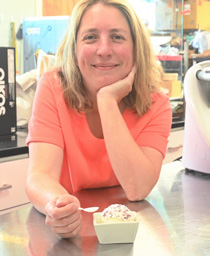
Enter Fairbank Construction Company, the Bainbridge-based design–build firm they’d first learned about from another of its projects in their neighborhood. They also connected with the owner of Archiments 98110, architect and interior designer Cynthia Carpenter, who joined the team, her role expanding in the way she loves most: taking a project from architecture all the way through furnishings and finishes.
Her first site visit confirmed what the couple had already felt. “How am I going to make sense of this house?” she remembered thinking as she walked through it. The entry didn’t exist in any intelligible way. Circulation was awkward. Some rooms were oversized and underused; others were dark and cramped, with windows placed high on the walls so you couldn’t see the woods or the water. The renovation’s first step became an exercise in clarity.
Bit by bit—starting from the interior architecture (for which permitting during the pandemic was relaxed), all through its design and finally to the exterior—Carpenter guided and integrated the process, which took about a year and a half. “The projects I like the best were the ones that I worked on through to the very end,” she said. “And this was perfect.”
Inside, some of the most transformative changes were rethinking the home’s flow. The staircase was relocated so that it no longer dumped awkwardly into the middle of circulation. A confusing series of small rooms near the garage was consolidated into a practical mudroom and generous pantry—solving the everyday problem of coming in with groceries and landing directly in the dining room.
On the north side of the main level there is now a library with a loft, which looks out to the water. “I really wanted a loft because as a kid, I liked having a place to crawl up to,” said Michael. The space began as a Lego-and-American-Girl-Doll hideout; now it’s where tweens and teens retreat to read or disappear with friends.
There’s also an ensuite guest room which is fully accessible, with a roll-in shower, wider doors and grab bars. “I use it as my exercise room when we don’t have guests, but if company is coming, then we reconfigure it,” said Christy. “We also designed this with the thought that this could be a parent’s suite.”
Downstairs, what had been a maze of mismatched spaces became a coherent sequence of a media room and bedrooms. Each of the kids has their own room looking onto the covered patio along with their own bathrooms. Christy was determined that no space would feel wasted, so nearly every nook now hides storage, a built-in or a tucked-away function.
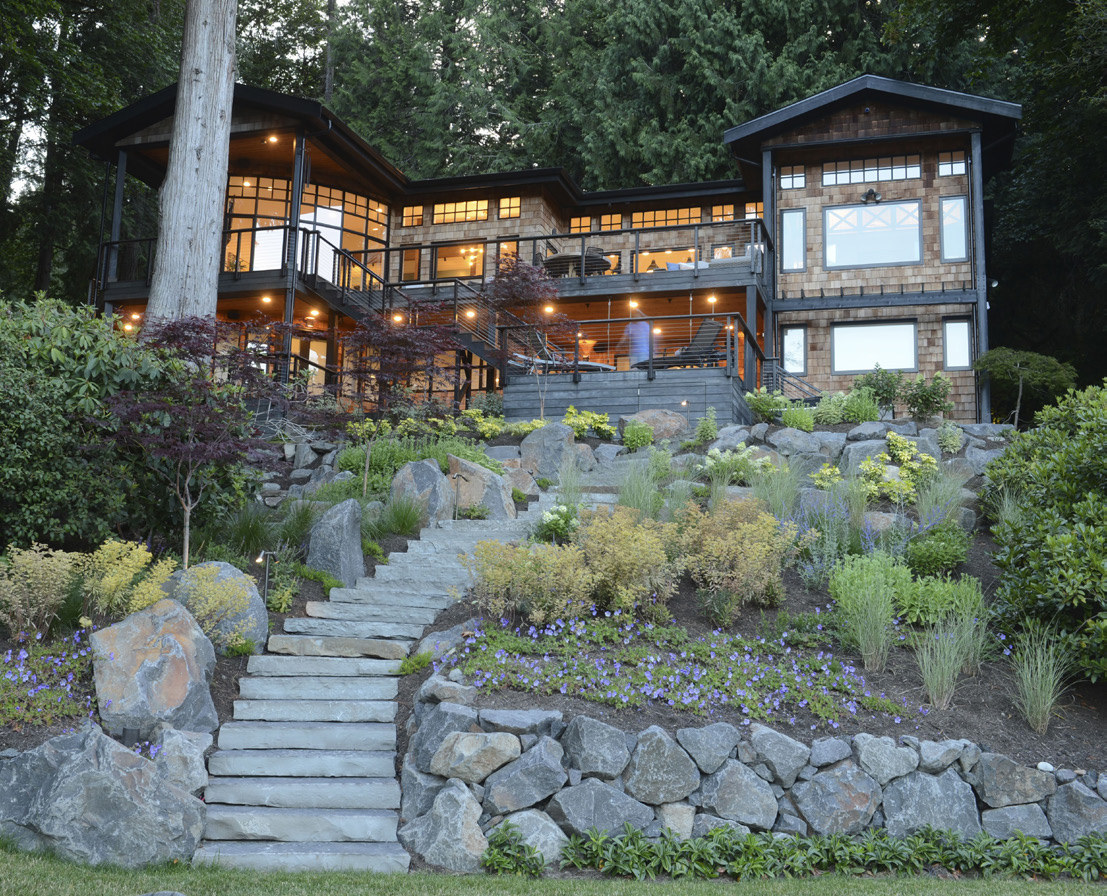
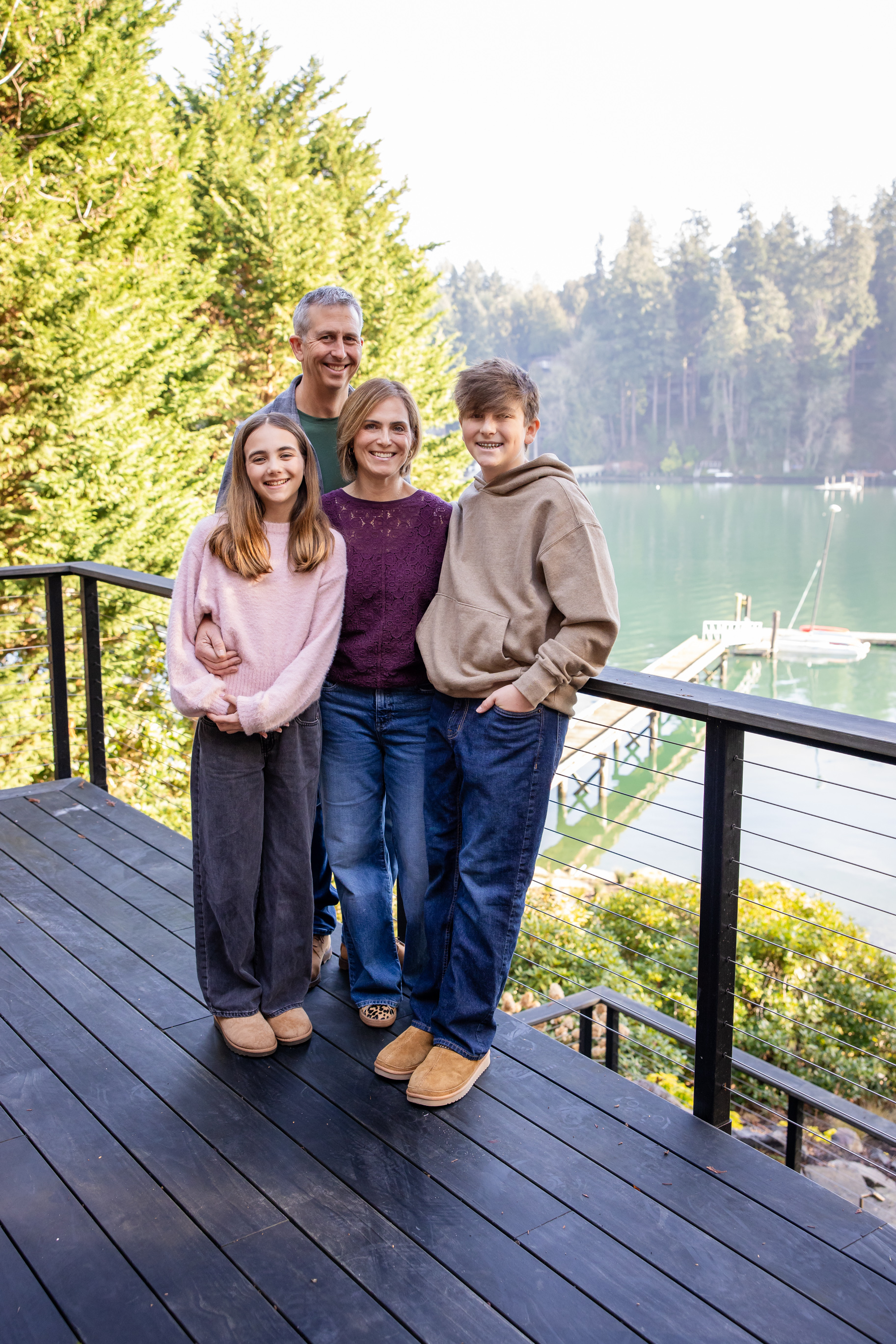
Outside, Carpenter and landscape architect Derek Reeves reimagined the approach, creating a real front entry and connecting the front and back of the home. Where there had been an ugly and dangerously decaying red deck and a dead-end façade, there is now a welcoming sequence: sloped paths that allow step-free access from the driveway, a covered entry and a deck that wraps the house and unifies it.
The added light throughout was essential. In the original structure, some of the most important walls—particularly to the south—were nearly solid, missing both light and views. Carpenter and the team opened those up with more and better-placed windows and skylights, orienting the main living spaces toward the water and the trees.
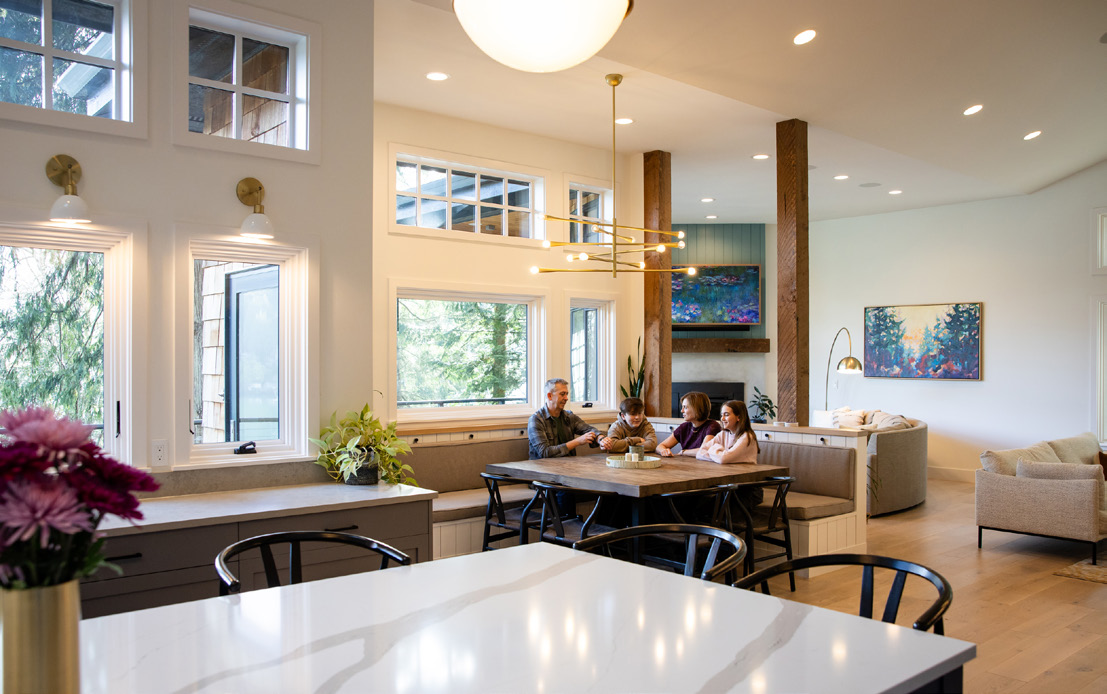
The kitchen, where the family spends most of their waking hours, is the heart of the house. Christy joked that she isn’t sure whether they cook because they love it or because, living in the hills above town in California, takeout was never really an option. Either way, decades of nightly meals—plus years of rental kitchens that didn’t work—gave them strong opinions about how a kitchen should function. Plus, they love to entertain.
The Boyds invested heavily in planning: banks of drawers instead of uppers, to make storage accessible to kids and shorter adults; zones for homework, cooking, and hosting; deep consideration of where every pan and plate would live. A large island in cool-toned quartz anchors the room, paired with a built-in dining nook that feels causal and welcoming rather than formal.
Features include custom gray-blue cabinetry, a built-in commercial refrigerator and wine fridge, double ovens, a huge island with seating at the end and a window above the kitchen sink that looks east to the water. Just off the kitchen is a galley-style walk-through pantry with a combination of cabinetry and open shelving, complete with a rolling ladder to reach the high spots.
Throughout the house, the palette—soft grays, watery blues, natural woods—reflects the landscape just outside the windows without slipping into “lake house kitsch,” as Christy put it. The aim was a restful, organic feel that doesn’t scream any particular style or era. “I always worry about spaces feeling dated,” Michael said. Their goal was a house that, 20 years from now, wouldn’t make a future owner ask, “What were they thinking?”
To that end, Carpenter steered away from trends toward enduring materials and shapes, occasionally punctuated by playful moments they all simply loved: a small bath wrapped in whimsical frog wallpaper, richly patterned tile and custom built-ins that show off the craftsmanship of Fairbank’s carpenters. Those touches feel personal rather than fashionable, a distinction that holds up over time.
One of the quiet successes of the renovation is how flexibly the spaces serve a family in motion. The kids’ loft above the library and the lower-level media/bunk room—with adult-scaled built-in bunks—with plenty of space to house nieces, nephews or an entire pack of visiting cousins.
Community and hospitality were also at the core of the Boyd’s planning. Soon after moving in, they hosted a neighborhood gathering, something their next-door neighbor—there for 35 years—said had never happened before. Since then, there have been a progressive holiday dinner, a boat parade party on the water, countless movie nights in the media room and regular clusters of kids on the covered lower deck, swinging from aerial silks or hanging out under the waterproofed structure above.
“We wanted to be the gathering house,” Christy said.
For Michael, now retired from Apple, days are divided between managing their California Airbnb, tending the gardens Reeves envisioned and that he has nurtured and exploring the island by bike. For Christy, life includes volunteering at Helpline House, seasonal coaching of middle school cross country and the ongoing work of helping two kids grow up rooted in one place.
They talk candidly about being in a liminal phase—“retired, but not retired,” as Christy put it—still tethered by school schedules and teenage rhythms. But that’s exactly what they moved here for: to be fully present for these years, in a house that works smartly for them and welcomes others. “Moving here was to be present in our children’s lives,” said Michael.
There are still projects ahead, of course: more landscape to develop on the far side of the house, a dock that could see more use, the inevitable small adjustments any home demands over time. But the big work—the transformation from a dark, disjointed structure into a bright, coherent home—is complete.
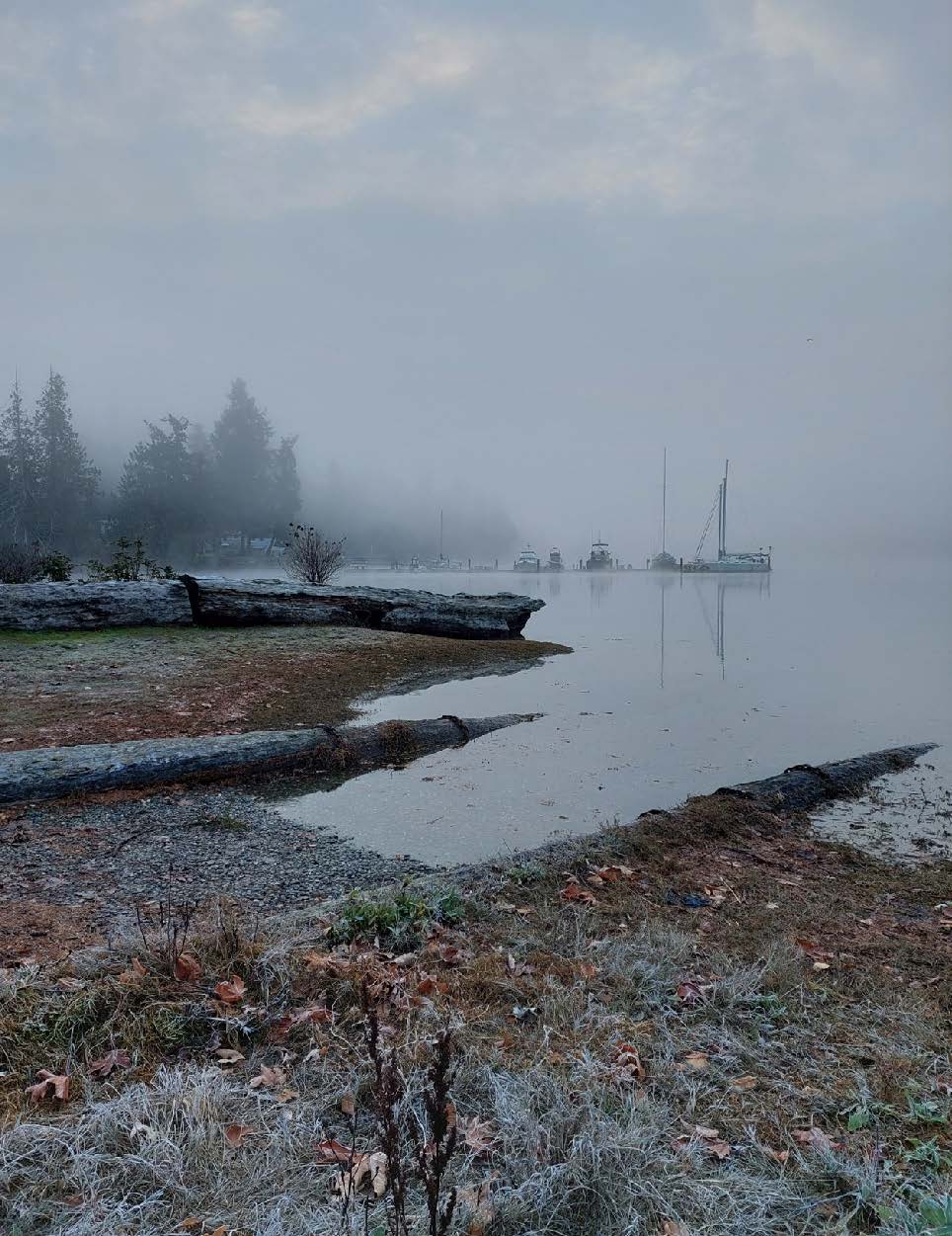
On a recent dark winter afternoon, Michael and Christy’s home was toasty warm and smelled of a wood-burning fireplace. Misty clouds hung low over the water and the surrounding Douglas firs are beaded with rain. From within, light spilled across the deck overlooking Manzanita Bay. Their two kids were just getting home from school.
The house feels exactly as the Boyds hoped it would when they took that first leap from a video walkthrough: a place that simply feels like home.