BET ON THE FARM
The Noble Push to Grow & Eat Local
BY CHRISTY CARLEY
PHOTOS BY DINAH SATTERWHITE
When visitors arrive at Perennial Vintners on Lovgreen Road, owner Mike Lempriere likes to start their tasting off with a bit of a geography lesson.
Lempriere, who has been growing grapes and producing wine on Bainbridge since the early aughts, explains the way the Cascades bifurcate Washington State and how the wetter climate of the west influences his choice of grape varietals: Zweigelt from Austria, Siegerrebe from Germany, Melon de Bourgogne from France.
Lempriere operates a tasting room out of his basement. He grows grapes in his backyard and on a piece of land that he rents from the City of Bainbridge, part of the historic Suyematsu Farm. When there’s time, he likes to offer guests a glimpse into the history of that land, including the forced removal of Japanese-American islanders to concentration camps during World War II. Just a quarter of the original Japanese-American strawberry farmers on the island returned when the war ended. The Suyematsus were among them, and their original land is now home to several working farms.
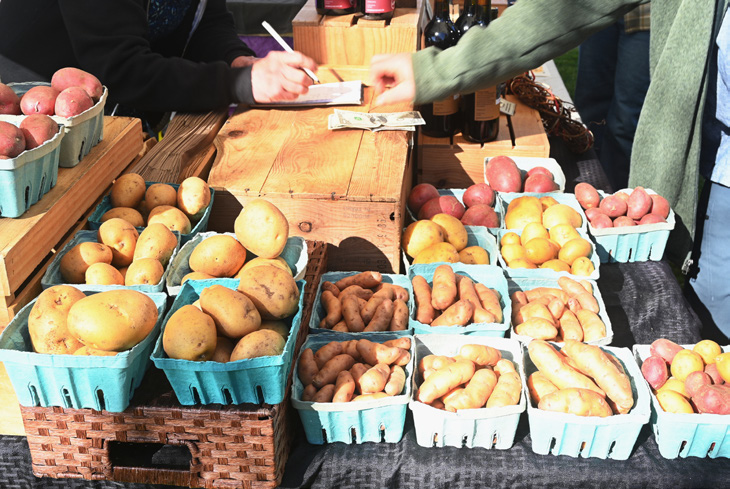
There are many obvious reasons to eat (and drink) local. Such products are usually better for the environment, requiring less carbon-fueled transportation. The food tends to taste better, since it can be harvested and prepared right before it’s consumed. In many cases, the fresher the food, the more nutrient dense it remains.
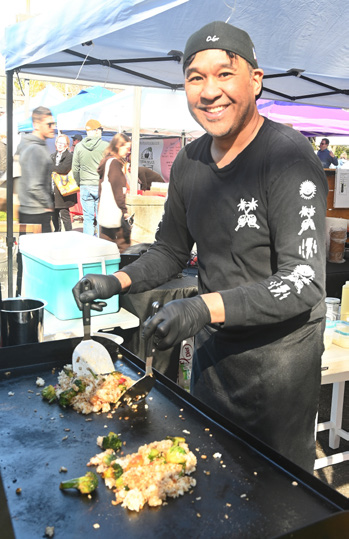
But there’s also the depth of experience that accompanies knowing where your food comes from, whether that means getting to know the people who made it or the history of the land where it was grown.
Washington is one of only five states without a statewide branding program for local food, said Clare Menard, a regional lead for Eat Local First. The Evergreen State doesn’t have an equivalent to the “California Grown” or “Colorado Proud” stickers that grace grocery purchases in those states.
In 2011, the Bellingham-based nonprofit Sustainable Connections started the Eat Local First collaborative to help address that gap. In 2020, the collaborative launched Food and Farm Finder, an online tool that allows people to search for a particular product or producer close to a given Washington ZIP code. It also allows users to filter their results for things such as CSA boxes, educational opportunities, farm stays, u-picks or other experiences.
The resource is free to use and also serves as a free advertising platform for those who grow and produce locally. To be listed, said Menard, businesses need to be owned and operated in Washington State. Farms, of course, must sell products grown and produced locally. Fish must be caught in waters bordering Washington, Canada and Alaska. In the case of a bakery or a restaurant, the business must purchase from at least two local producers and be working to meet or exceed 10 percent of their food budget on food grown or raised in the state.
Bainbridge boasts a total of 19 listings on the site, including Town & Country, Pane d’Amore and a number of local farms and vineyards.
Farming has never been an easy business, but as fuel prices and inflation climb, community support is more important than ever. For farms, especially smaller operations without a strong online presence, Menard hopes that the site will serve as a hub for connection.
“It’s really hard for farmers to grapple with inflation while keeping food affordable, knowing that everybody else is also facing the same strain on their finances,” she said. “We’re making a bigger push so that we can get more farms to sign up, because the more businesses that are in this directory, the more impactful it’s going to be.”
Perennial Vintners is among the 19 businesses listed through the Food and Farm Finder on Bainbridge, as is Butler Green Farms, owned by Brian MacWhorter, who has been farming on the island for 42 years.
MacWhorter said he’s continually impressed by the island’s commitment to local agriculture.
In 2001, Bainbridge voters approved an $8 million levy to preserve open space on the island. The city used a portion of that money to purchase farmlands, which it now rents to local producers.
“It was kind of mind-blowing that that many people who didn’t have farms wanted to protect farms on the island,” MacWhorter said.
MacWhorter uses the word “community” a lot. Through the nonprofit Butler Green Farm School, he mentors young farmers and teaches a horticulture elective for high school students. Butler Green also provides educational opportunities for younger kids. He hopes to cultivate curiosity about where food comes from, and as the U.S. farming population ages, grow a new generation of producers.
“I certainly want our kids to have access to the farms into the future,” he said. “Getting one’s hands dirty in the soil, tasting baby carrots right from the ground and appreciating what an amazing gift our island farms are to this community.”
Explore local food options at eatlocalfirst.org