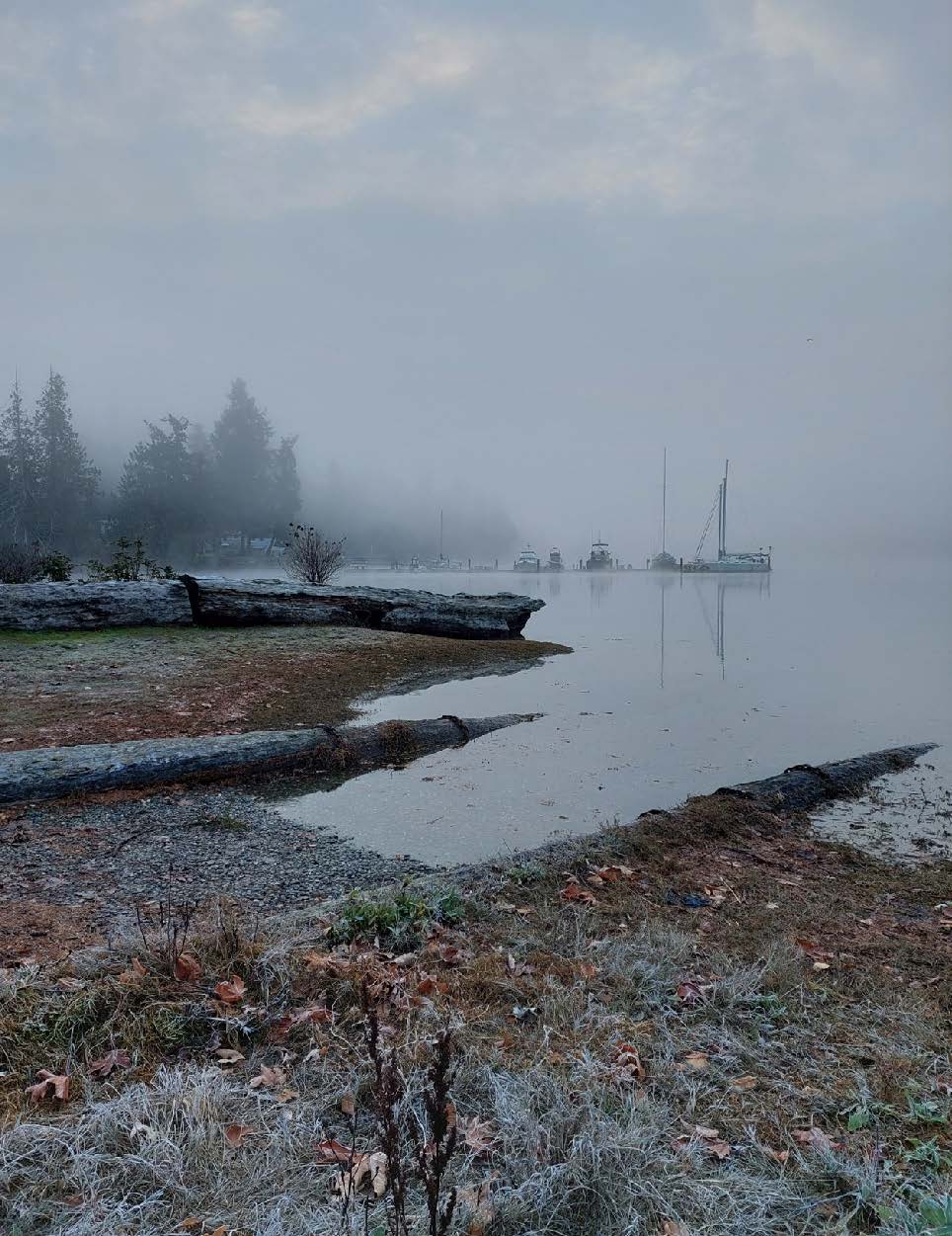
A Very Good Footprint
Sunrise Home Becomes a Collector’s Canvas
by Alli Schuchman
photos by Kelvin Hughes
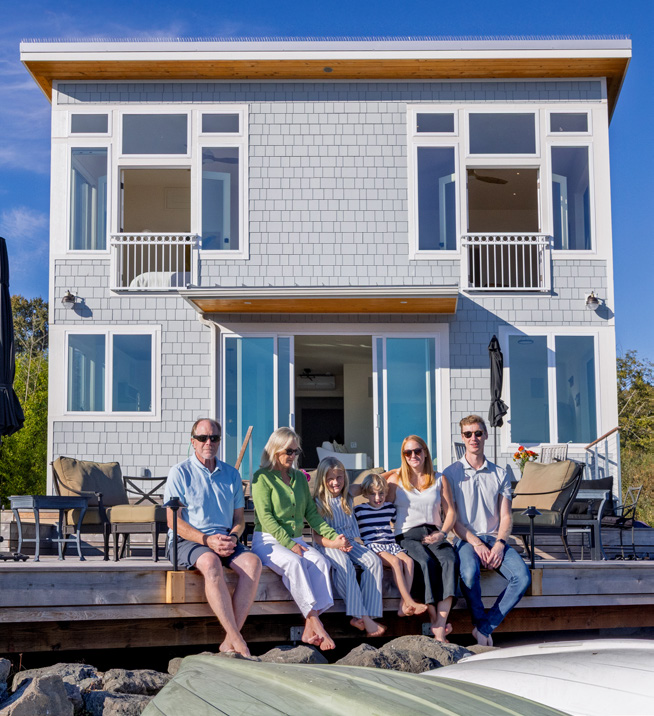
Kris Rogers and Brad Butler moved into their cabin on Hawley Cove in the early ‘90s when the older of their two daughters was just 2 years old. Built in the mid-‘60s by Calvin Hall, the humble one-bedroom, 650-square-foot structure became their family’s home over the next 35 years.
During those decades the home did slowly transform—first to two bedrooms, then to three—to meet their growing family’s needs. Most memorably, though, it was a haven for birthdays, gatherings, celebrating the Fourth of July (which is also one daughter’s birthday), ferry-watching and taking in the beauty of Puget Sound.
“It was funky,” said Butler who explained that the changes were largely born of necessity. “We would have never done anything. We would have just left the house the way it was.”
Sadly, however, climate change had other plans for the simple beach cabin. Butler explained that the house—which was set upon creosote pilings and had little in the way of a proper foundation—made it especially susceptible to flooding from the rising waters. Over the last decade, as the reality of their home’s location set in, the couple grew increasingly anxious each winter, fretfully watching the tide calendar and barometric pressure, which were progressively bringing the water closer to their doorstep.
Their breaking point came on December 27, 2022, when an extraordinary king tide flooded the cabin’s two downstairs rooms. Rogers recalled being piggybacked out to the car through knee-deep water to make it to the “Nutcracker.” Butler said they could no longer live on edge, playing what they described as Russian roulette each winter. The original cabin—despite being steeped in memories and shaped by decades of family life—had become too much of a liability.
But figuring out what exactly to do wasn’t straightforward.
Butler and Rogers conferred with Nickel Bros. about lifting the home and building a proper foundation underneath, but the architects and structural engineers concluded that the complex retrofitting would cost roughly the same as building a completely new home from the ground up. But rather than just razing it—an option the couple desperately disliked—Nickel Bros. came up with a better idea: to donate it to House Donation Group, where it would be sold to a new family and moved to a better location.
Nickel Bros. handled the relocation. “The project was pretty interesting,” said Butler. “Getting it over the rock wall, the bulkhead…the equipment they have and how they do everything is amazing.” The couple explained that getting the barge free from the shore took more than a little ingenuity and effort after the receding tide left it partially aground.
Once freed at sea, the old cabin was floated to Whidbey Island, where a young couple—one of whom grew up on Bainbridge—restored it atop a new foundation. “They are just taking off where we left off,” said Butler. “Love and young energy there. It looks good.”
Back on Bainbridge, designing and constructing the new home could then get under way. Because of the property’s location and its proximity to surrounding wetlands, the new house needed to be built precisely on the original footprint to comply with zoning laws. Butler and Rogers worked with architect J Mack Pearl and structural engineer Paul Fagét to create the strategy that would elevate the new structure by four and a half feet, providing greater protection against future floods. To execute the plan, Rogers and Butler hired general contractor Gene Knox of Blue Fish Designs and craftsman Ross Maloney, who is still on site putting the final touches on the house.
The home’s new foundation is a thick, reinforced concrete mat slab, which is anchored by expanses of rebar and surrounded by steel-reinforced stem walls to allow floodwaters to flow beneath it and back out, sparing the living spaces above.
Marcos Larios of Kitsap Custom Concrete spearheaded the foundation’s technical work. “They were great,” said Butler. “There is a lot of concrete in this place. Foundation and stem walls. It's probably the most expensive part of the house.”
Atop the foundation, the new two-story home is clean, thoughtful, sophisticated and bright. It ended up around 1,950 square feet with two bedrooms upstairs, along with the primary’s bathroom and a sitting room that overlooks the beach. On the main level there’s an additional bathroom, stacked laundry, kitchen and living room, and a little TV room sits at the back.
Polished concrete floors with radiant heat, as well as blown-foam insulation in the walls and roof, enhance both its energy efficiency and comfort. The couple said the home’s temperature is markedly more comfortable than the old cabin, which Rogers said would get, “hot, unbearably hot” in the summertime.
Throughout the home, large e-glass windows frame the water and passing ferries, while minimizing ultraviolet light and energy loss. There are also mini splits, but Butler said he doubts they’ll ever use the one on the main floor because the house is so efficient. “One of the biggest differences between the old house and this house is how cool this house stays,” he said.
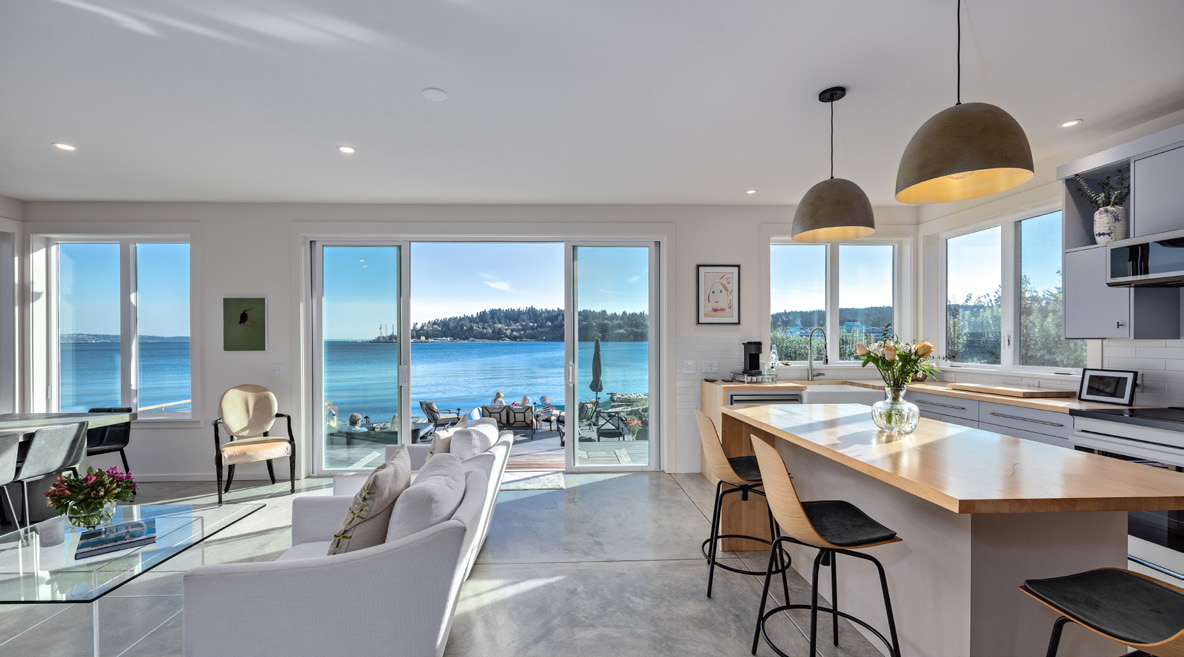
The sleek kitchen—open to the family room and on the water side of the home—was designed and built by Maloney and his father, an architect himself, who also helped design the deck, a beloved space of Rogers. “I read out there; it's peaceful. I just love listening to the water. And there are always kids down there. I love listening to them playing,” she said.
The Ipe wood deck overlooks the beach and out onto the 11-acre Hawley Cove Park. Wildlife frequent the view: kingfishers, ducks, osprey, seals, otters and—for the first time recently, orcas. “It's like having a huge, free backyard,” said Butler.
When they first moved to the property, he said that otters tried to take up residency under the old house. “We had a Jack Russell terrier and at one point there was a two- or three-day battle between the terrier and the otters, and finally, Zippy prevailed and chased them off.” Recently, they spotted one in the yard, but so far there’s happily no sign of otters going under the house.
Beyond the beach, the house looks across the water at Pritchard Park, where Rogers said their daughters would kayak to when they were in high school. And slightly to the southeast, an unobstructed Mount Rainier towers up from the horizon, appearing unimaginably immense for being more than 50 miles away.
The couple has plans for more landscaping, although they agree the natural surroundings aren’t too bad. “The yard is super small, so it's not like a big landscaping situation has to occur,” said Rogers. “We'll focus on more of the planting next spring. I’ll get some big pots.”
Their home remains a favorite gathering spot for their friends and family, including their daughter and her husband who live on Bainbridge with their kids. Rogers said she hopes they’ll continue to use the house for many years to come. “It'll be a nice place for our kids to have as something that they share.”
As far as Butler and Rogers? It is, as they say, their forever house—ready to host the next generation’s stories as well.